I flagged the article. The author exploited clickbait titles and western guilt to craft his own narrative. People are going to read this poor cluster of pop history and get a very wrong idea of the Roman Empire. The second part of the article was quite fascinating but how can I possibly trust the author after statements such as Imperial Rome was a dim backwater by comparison.
"The truth is, though, that Rome’s Asian contemporaries completely dwarfed Rome in almost every respect: heritage, population, cultural diversity, technology, architecture, medicine, philosophy, poetry… I could go on, but you get the idea."
There's a few points where he exaggerates or otherwise overstates comparative claims about Rome, but his research into the antiquity cultures of Asia Minor/the Middle East is both accurate and refreshing considering how little recognition they get outside of anthropology and (specialized) classics. The comparison of contemporary Chinese and Roman power is also a valuable one - it's not often brought up in either one's respective historical studies.
It's worth keeping in mind that this is a Medium post by a blogger. It's not peer reviewed, and it should be read with the author's opinions and goals in mind.
It's unfortunate that you flagged the article and let your bias take over. The article, ignoring mislabeling of images, is still a work of research.
> Imperial Rome was a dim backwater by comparison.
And it was, by comparison. Why do people have the audacity to think that Rome alone was greater in all aspects than the collective synergy of Persia, India, China, Swahili Coast etc? These regions were in extensive trade and cultural contacts and the cold hard truth is we Europeans were not a central part of that scheme. That's why Asians devised decimal system, paper currency, and wooden block printing, compass, and other ground-breaking inventions, due to its sheer vibrancy.
No, Indians devised the decimal system, wasn't adopted by the rest of Asia. Instead it spread west and was adopted by Europe before the countries east of India.
> Asians devised paper currency
No, China devised paper currency, wasn't adopted by the rest of Asia, but was adopted by Europeans when they encountered it.
> Asians devised wooden block printing.
Again this was China and it didn't spread to neighboring countries for centuries.
> Asians deviced compass.
Just China and was adopted by Europeans before other Asian countries...
So most of your examples were adopted earlier in Europe than in Asia, so it seems like Asians mostly traded goods and not ideas.
And stating that Rome was a backwater country is patently false given that they had by far the most advanced architectural techniques at the time. They might not have been the most advanced in every field, but it is not like they were that far behind either.
I am not OP, but looks like (s)he's trying to say that Rome was not the paragon of science and invention, and indeed the major action was happening in Asia. Rome was a great civilization, but it paled compared to the combined power of Asian civilizations, which was the scene of multiculturalism, trade, philosophy, science, and prosperity.
Now to nitpick your claims:
> Indians devised the decimal system, wasn't adopted by the rest of Asia
I'm pretty sure the Persians, Arabs, Tibetans, Samarqand, and South-East asians were using decimal system extensively. It was adopted pretty much widely in Asia. BTW India is in Asia, and that makes them Asian.
The compass was adopted by the central asian and south asian sea fairing states. It simply didn't leap from China to Europe.
> they had by far the most advanced architectural techniques at the time.
Which is a grand and unsubstantiated claim. The Great Wall Of China, Indus valley grand megapolis, Persepolis etc stand witness to the grand architecture of the East. Rome while had great architecture, wasn't necessarily superior to any of these.
My main point was that Asia wasn't a vibrant cultural region which shared ideas extensively.
> The Great Wall Of China, Indus valley grand megapolis, Persepolis.
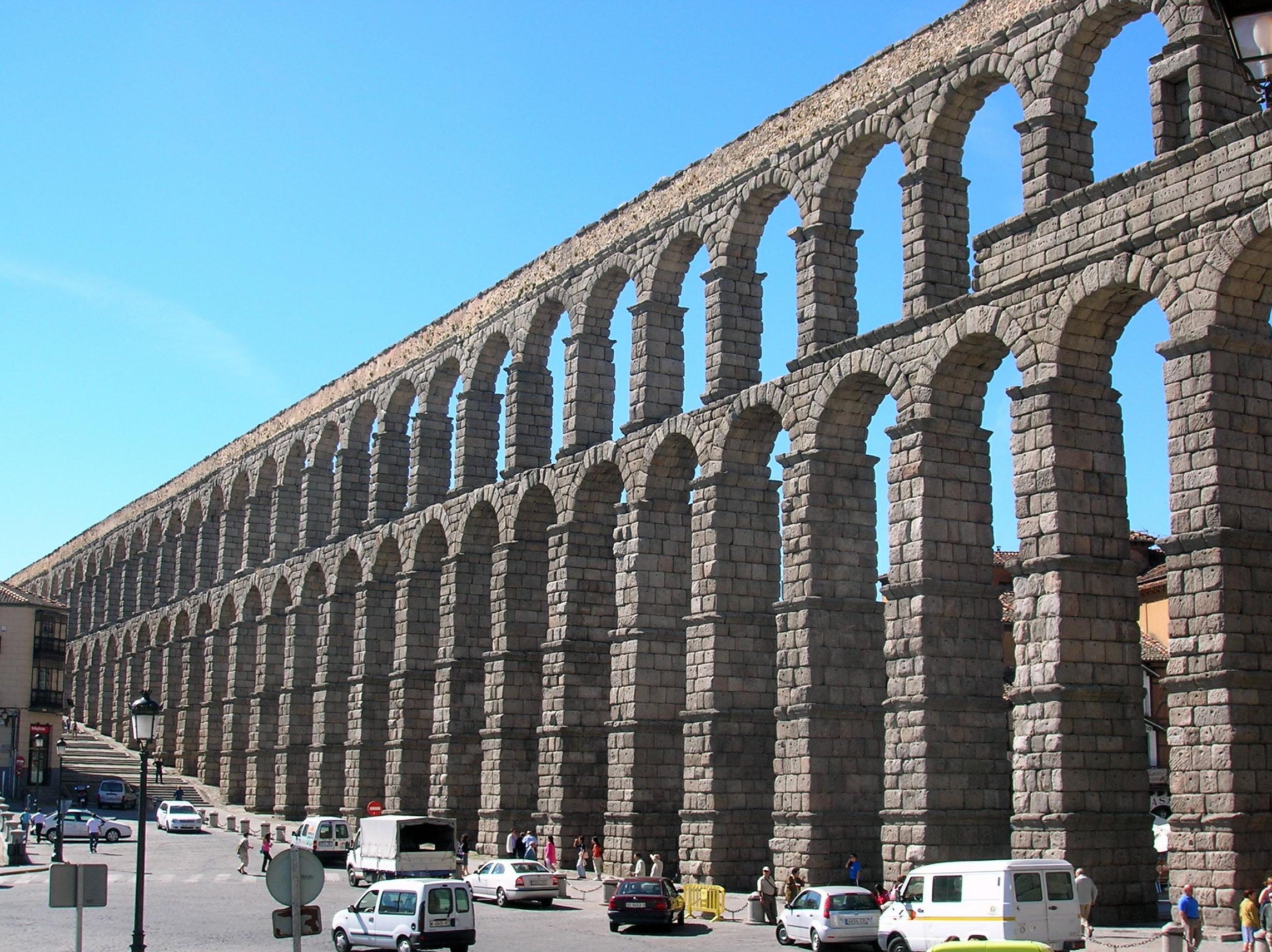
Those doesn't require more advanced architectural skills than just knowing how to pile bricks, Greece and Egypt built similar things long before the Romans. Roman architecture allowed them to build impressive stuff with far less effort which is why they were able to build hundreds of aqueducts.
Also most of the Great wall of china was built more than a thousand years after Rome's prime, so it doesn't count. The ancient parts of the wall wasn't much more than a very long rock fence, not really comparable to roman aqueducts.
> Those doesn't require more advanced architectural skills than just knowing how to pile bricks
So building aqueducts is impressive than building a complex functional megapolis, in the bronze age, with top-notch sewer system, with millions of people? Not sure what to make of this claim. I would still love to see evidence of the 'impressive stuff' that Romans built that was way ahead of all of the world civilizations.
...originally was mostly made of rammed earth and wood; it was rebuilt using brick only during the Ming Dynasty (1368-1644). The Great Wall that tourists take photos on today has very little in common with the primitive Wall of two thousand years ago.
"Rome while had great architecture, wasn't necessarily superior to any of these."
Actually, it was superior and that was thanks to a very impartial thing - concrete. You have concrete, you can build things that others without concrete can't. That's it!
I'm pretty sure the author went to great lengths to ensure that it is patently obvious to the western reader that the article should be taken with a grain of salt. In fact, that's the entire point of the author's writing style...
If other words, if you think the thesis of this article (that Asian cultures were objectively dominant over Roman culture) is the intended take-away, then you've kind of missed the point of the article.
The thesis of the article isn't the point of the article? What?
You sound quite defensive for a throwaway account. (If you're the author, your article has lots of good research on the details of Asian empires, but making broad claims about history is something which should be approached with caution).
> The thesis of the article isn't the point of the article? What?
Kind of like how an article whose "thesis" is that we should eat children probably isn't actually suggesting we literally should eat children, even while making a vigorous argument for its thesis.
Or are you also flabbergasted when someone suggests "A Modest Proposal" wasn't an actual proposal?
What the author did in this piece wasn't exactly satire, but it is using hyperbole to make a point about a form of bias in historical writing (cultural exceptionalism).
> If you're the author
I am not. But I enjoyed that article on its own merits, and seeing a nice piece of work trampled over by people who completely missed the point of the piece angers me.
>...but making broad claims about history...
The point of the piece is not to make broad claims about history, but rather to critique the sorts of broad claims that are often made when history is written from the perspective of a culture that views itself as exceptional. The fact that the claims are so hyperbolic as to make people angry is... kind of the point -- c.f. modest proposal.
I thought that was patently obvious from the tone and content of the piece.
>how can I possibly trust the author after statements such as Imperial Rome was a dim backwater by comparison.
Well you could read the rest of the article and see if the statements hold up...I see nothing in your comment that justified what was essentially censorship on your part.


The premise of the article is flawed too, we don't know enough about the 'chinese' skeletons yet: http://www.forbes.com/forbes/welcome/?toURL=http://www.forbe...
"The truth is, though, that Rome’s Asian contemporaries completely dwarfed Rome in almost every respect: heritage, population, cultural diversity, technology, architecture, medicine, philosophy, poetry… I could go on, but you get the idea."
Read this article with a grain of salt.