For money, my dear, for money. Is there any other reason for a company to exist? The stuff like "do no evil" or "we are green" is just a smoke screen. At the end they will do everything for money.
That has been the answer for last era. I think that’s why tech workers are starting to ask what we’re building it for. Because we’re here at this point because building “for money” is no longer good enough. Because what’s the point of having money when we’re cancer ridden and polluting our planet, and despite living in a rich planet people are starving, and the very resources that feed us are being destroyed. What’s the point of a pile of money when there is nothing else left?
> despite living in a rich planet people are starving
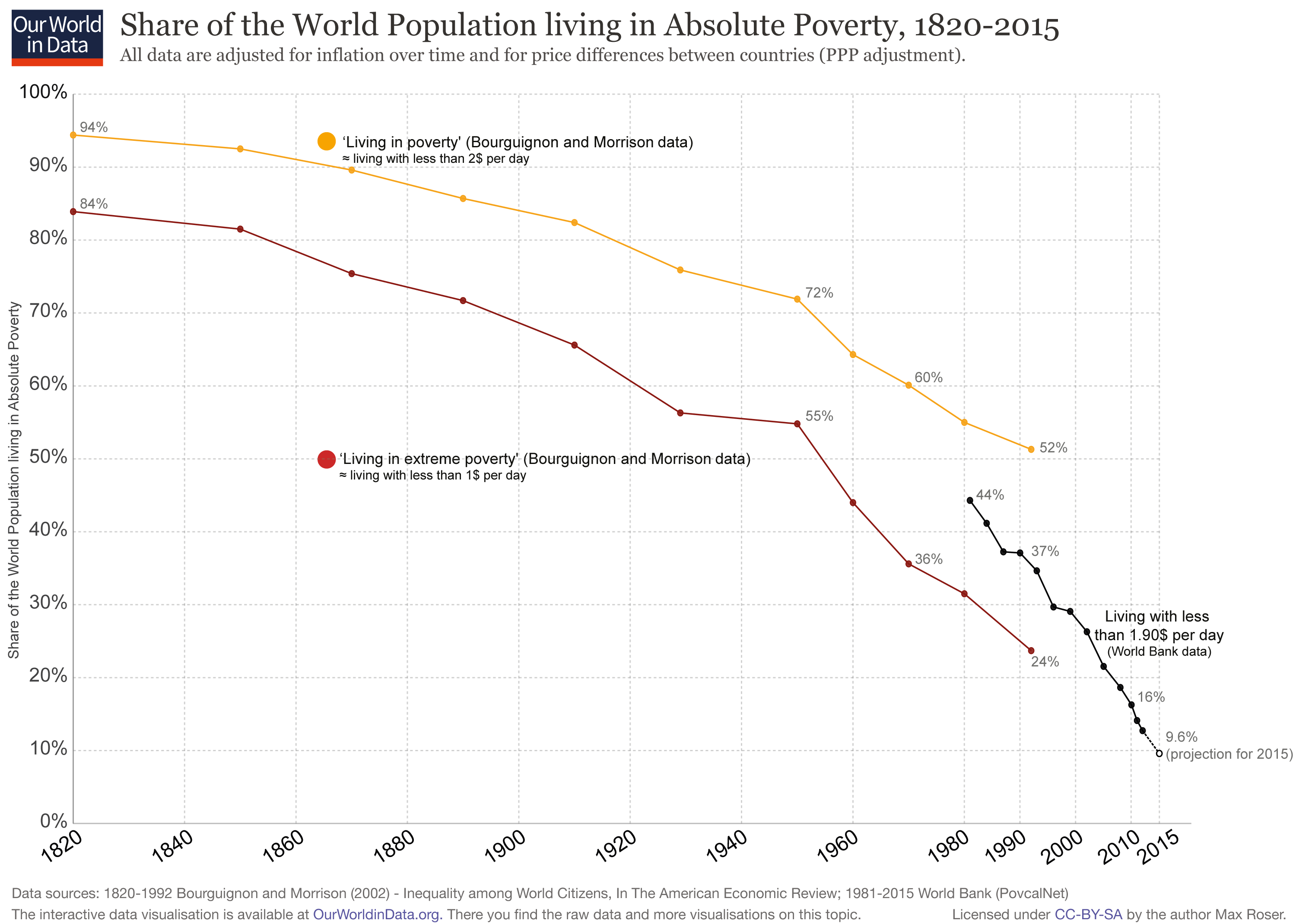
A overused rhetoric that does not hold much ground when you realize that poverty is decreasing fast everywhere around, and faster than we expected it to.
The way we measure a "decreasing poverty" is extremely laden politically (like most things that are supposedly "neutrally evaluated" are supposed to be, just because they're represented as spreadsheets of numbers).
We consider that a villager living from subsistence farming and therefore having almost no use for money to be part of the very poor, less than 1$/day crowd.
Take this same peasant and send it working for some multinational company harvesting cocoa or sugar cane, under horrible, exploitative conditions for 2$ a day, and bam! poverty has been halved!
Ditto if you send him and his family in some shanty town collecting plastic on a rubbish pile, feeding on refuse : he's now making 3$ a day, poverty decreased again!
What is called "lifting out of poverty" is actually "making them a cog of a worldwide, money-based economy". That's a mixed blessing, to say the least.
Well, for one, that would require you to be able to have land to do so. I would be shocked if many of these people had an actual, freely available choice on the matter.
Buy cheap land out in the middle of nowhere and start farming enough to provide food for yourself and some excess to pay expenses. There is a reason people don't do that.
The thing is, being a cog in the capitalist wheel really _is_ preferable to subsistence farming. The reality of subsistence farming is that you're living with no access to healthcare, education, often subject to food insecurity, and often lacking in basic utilities like electricity and clean water. Subsistence farming isn't all hunky dory like the Hobbits in the Shire. There's a reason people choose to escape it when given the chance
I have no idea how to find it again, but I read an article about indigenous peoples being forced off their land and into the city. They went from hunting, gathering and fishing and a life they loved to terrible slum conditions and racially motivated violence against them, up to and including murder.
They weren't actually subsistence farmers, but they did live without money before this was done to them. They were incredibly bitter.
And people forced to become cogs don't automatically gain meaningful access to things like healthcare and education, plus the education of the city people can involve horrible prejudice that is actively harmful to them for various reasons.
I was mostly opposing the view that "people are starving". It's well known that mass starvation is pretty much gone from the face of the Earth. Now the only places where people really die from starvation are conflict zones, or places hit by natural disasters. I am willing to admit there is are still "hunger" problems in many places, and malnutrition too, but hunger is not starvation.
What metric is that measuring? The standard of living? Or the amount of money people have? Because those are 2 very different things. What about access to affordable health care? Access to clean water? Access to nutritious food? Poverty measures so many things. Not just having money and wealth.
Absolute poverty is the important measure. If I'm hungry, I'm hungry, no matter what my neighbours have. But if I have a 50" flat screen TV, and my neighbours have a 100" flat screen TV, that inequality does not make me poor. I can still watch TV.
Then the solution is to build more housing, so that supply increases the point of making it cheap again. A lot of housing scarcity is caused by zoning regulations.
Wrong. If you do not have have what the average person in your society has, you'll struggle to participate in your society (in an absolute sense) and you'll be treated as an inferior, which does all kinds of harm (in an absolute sense).
If I live aboard a ship, I am not in poverty because I do not own a car, because in my society, you do not need a car. But if I live in a city with no public transport where you need a car to get around, but I can't afford one, I absolutely am.
Poverty apologists always bring up TV as an example, as if poverty is about optional extras rather than basic dignity, respect and participation.
I don't think you really want to go down that road... Historically, most societies have "chosen" a set of expansive "rights" for the top and limited rights for the bottom. I say "chosen" because most societies had it chosen for them by whoever conquered them, or at best, the lower classes had it chosen for them by those with power.
Many people do think about starving kids when they hear "poverty" though. There would be much less outcry in media if everybody realized it's about kids having smaller TVs rather than truly starving.
There's a running joke in my country that US poverty is our middle class - only two cars and a small house.
It is still plenty good enough but employee want to be paid in the currency their employers uses.
If you trust your employer to do things for the greater good, you can accept less money, or even no money at all like with the charities. If your employer is simply pursuing the highest profit, employee want the biggest amount of money.
Banking never could claim a "Moral High Ground", so they compensated with cold hard cash. SV is loosing its and needs to align its salaries accordingly.
For money is good enough for me. You probably doubt me, but I'm not callous, mercenary or indifferent to the experiences of others - I'm just buying into a system that is objectively working. Spend some time clicking through https://ourworldindata.org/ ... we're not doing as badly as you seem to suggest.
Yeah, mankind is in overall in the best shape it's ever been, and the numbers reflect that across many metrics.
But what about climat change? We've improved so much across so many areas, surely that'll offset a few more degrees across the globe? It's just one metric among so many where we're doing great.
What if it doesn't? How will we cope in 50 years with hundreds of millions of landless refugees? Right now we can't. Are we doing so great that in 50 years we will?
While I agree we should be asking, "what are we building this for", it is a two edge sword. There are a LOT of BS tech jobs that may go away because people are asking this question.
Cure for cancer involves molecular biology and filtering pollution involves heterogeneous catalysis. Where does programming come into play in any direct way to these solutions? I understand that tech is involved indirectly, but so is the coffee that is served in laboratories to keep scientists working.
> Where does programming come into play in any direct way to these solutions?
* Literally every piece of lab equipment that uses any kind of controller/control board (most of them)... has needed programming of one sort of another. Hmmm, with the exception of older analog gear maybe (decades ago?).
* Every single piece of data collection, storage, analysis, and control software is created through programming.
* Even communication of results among team members, to management, to the public, often requires programming.
I agree programming is involved with all solutions that will come from sciences. But considering how many people use macs, powerpoints, and word in those industries, I think those who are working at companies like Apple and Microsoft are contributing just as much as somebody who works as programmer at start-up involving heterogeneous catalysis.
I was under the impression that pre 20th century companies just existed as a legal and organizational convenience in order to help collect a number of people with similar goals rather than to solely make a profit.
If anyone knows what I'm trying to say and can put it in clearer words that'd be lovely, I think I'm missing an important linking idea here. Anyway...
Imagine there are two paths from A to B (the left and right path). 100 people walk from A to B. Half take the left and half the right, and none of them have any information not in this paragraph.
There are wolves on the left path. Everyone who travels it gets eaten. Now, at B, we have 50 people. They all chose the right path voluntarily, they all made a choice. None of them knew about the wolves though. How do we catagorise this situation in term of having and not having made a "real" choice? I argue that in practice, whatever the people were thinking when they chose B was irrelevant, because they didn't know the thing that actually mattered and they didn't have a proxy variable for it.
With that setup, I'd argue companies that "help collect a number of people with similar goals rather than to solely make a profit" are a lot like my right path, in that the people may not have been focused on maximising profits, but if they didn't achieve them they wouldn't have lasted long. By evolution, there will be a decided drift towards companies maximising profits even if all the individuals actually making the choices think they are doing something real (or I suppose, the converse where they think that their job is meaningless).
This is something like "survivorship bias", but that term is usually applied to extreme outliers like CEOs rather that average case people like you're doing.
I'm not sure the drive is less so much as PR is a thing, better regulation is a thing and the internet makes corporations misdeeds much more transparent.
This is one of the reasons among many I regard the decline in proper journalism as so worrying.
That's not right. USA Antitrust law was invented around 1900 to fight excesses is service of profile.
A corporation could be chartered for any reason. What is true is that in the early 19th century there was a legal pretense that corporations had to justify their charter to the government in order to be approved and renewed.
> I was under the impression that pre 20th century companies just existed as a legal and organizational convenience in order to help collect a number of people with similar goals rather than to solely make a profit.
You might want to have a look at an history book then. Companies had slaves, got kids working in mines, got to use the government to shout their workers who rebelled because they had no rights whatsoever, or just straight up used private armies. It was all pre 20th century already. If all this was not solely to make a profit, I don't know what it was.
Furthermore the great majority of big ventures were family driven. There were not formal associations between "people with similar goals" who weren't blood related.
I've read just about every non-fiction account I can get my hands on about business in the ~1850-1930 era. The drive for profit during the industrial revolution, was radically stronger than it is today. The giants of industry back then openly lusted after success, it was culturally acceptable to behave that way (right up to the point where you were dominant, then the people turned against you). They made no apologies for the all-out pursuit of profit back then. Rockefeller dressed it up slightly, by proclaiming that god wanted him to be rich, that to be wealthy was glorious. The so called robber barons lived in openly ostentatious ways that today's rich in the US would mostly never dream of; today most of them go out of their way to pretend they're not so rich and to hide it. Open shows of wealth today are considered closer to vulgarity, crude, disgusting, etc. Back then, it was far less widely believed that wealth was stolen from 'the people'; today, it's widely believed that the rich are all thieves in some considerable manner. There was no welfare state at all, income taxes were extremely low or non-existent, so the accumulation of wealth happened far faster. Companies often paid extremely high dividends 10 to 20 times higher than is normal today.
Tactics, when it came to dealing with competition, were far beyond anything you see today. There were few regulations in the US, so companies were free to devise all manners of schemes to best their competitors. The treatment of labor in the pursuit of profit, was similarly far more brutal (there's really no comparison, Amazon's warehouse workers are treated like kings compared to sweatshop workers back then).
Companies began as a means to have an endeavour progress while the people involved changed [0]. The nature of the endeavour could be profit, but by no means had to be.
Personally, it should not negatively impact lives. For example, I can't see myself saying "I will take this job for the money, and the gun I help engineered is used to kill humans during combat".
I don't work in the field and don't know exactly how I'd personally feel about it, but I can see a very strong argument that even one of the most heinous weapons every deployed on Earth likely saved a net million-plus lives.
If that is the case, is it moral to refuse to work on the Manhattan Project if asked?
(I also agree that working on the next generation of the atomic bomb or the next revision of the M16/AK47 does not hold the same promise of saving lives, of course...)
There is. It's a solved problem. The only issue is lack of info (many evil people vs 1 good) but most people get stuck because of a "no compromises" attitude and lack of will to make that decision.
Modern society has already made the choice though. We sacrifice a few for the many all the time, and they are called heros and duly celebrated.
>One of the most heinous weapons every deployed on Earth likely saved a net million-plus lives.
It's really an argument that can't be made because the other event never happened. The weapon killed people, that's it. I don't know if there's a moral side at all?
The projections for the invasion of Japan during WWII were that there would be millions of casualties. The battles in the Pacific were some of the most fiercely fought of the war, and invading Japan would have been even more so.
Agree you should not work for something that is not align with your moral and personal believe, as for me I can totally see myself saying "I will take this job for the money, and the gun I help engineered is used to kill humans during combat".
Say I have an idea for how I want the world to be. I don't care about money at all, but my vision is too big to execute by myself. How do I get people to help me without forming a company?
They join the army to protect their nation and the privileges we have. So your family can have dinner at night without worrying about people from a neighboring land busting in and stealing your property , kidnapping murdeing raping family etc
They are people who are signing up for a job whose work benefits are medium probability of making their spouses widows and single parents overnight
They also join because of solid signing bonuses, good training, GI Bill, and a good resume item. Let’s not kid ourselves about the economic make-up of our enlisted military.
I am not saying that they did not sign up for the other reasons as well, and by saying this I don’t think I am undermining their commitment to serve or their intent, but in a volunteer force it is also about money, and we’re going to have to pay a lot more to meet recruitment targets.
The current obsession that companies exist solely for making money for shareholders is an historical aberration. If that's still the common view in a hundred years or so, it will carry more weight.
> The current obsession that companies exist solely for making money for shareholders
Making money for shareholders is an instrument to secure long term/regular investment. It's not the "end goal", and almost no company's mission is "to make money". Money is just the blood stream that enables everything else.
> It's not the "end goal", and almost no company's mission is "to make money".
Sure seems that way, when every decision is optimized towards making money short-term. I think the more correct model of most companies would be money-focused entities that through path dependence ended up in the market sector they're in. That is, the actual thing they're doing is an artifact of history and is abstracted away for actual operations.