> They have also asked that lawmakers amend the Constitution to abolish the 13th Amendment exclusion that allows slavery and involuntary servitude as punishment for a crime.
Slavery work and for profit prisons may incentivise to send as many people as possible to prison. It seems a bad incentive if you are looking for a fair justice system.
This is not a hypothetical problem. Former slave-owning states passed Black Codes that made it easy to convict blacks of things..where they wound up in prisons where they were leased out as workers. Since it mostly happened to blacks, nobody cared much if there was much fairness in the process. And given the economic incentives, it was done fairly liberally.
Oh wow I didn’t know that. All of a sudden it makes the lyrics from “Jedi Mind Tricks - Shadow Business” make sense.
> Slavery's not illegal, that's a fucking lie
It's illegal, unless it's for conviction of a crime
The main objective is to get you in your fucking prime
And keep the prison full and not give you a fucking dime
What I'm saying is that not every opinion deserves to be taken seriously enough to merit an argument. There are plenty of opinions which deserve mockery and contempt.
Yes, kinda? I mean, we basically replaced slavery by machine work, no? Its "free labor" as machines do not try to escape, and are fed with stuff we find underground so they don't compete for our food.
I don't think slavery would have been abolished without the industrial revolution.
> Its "free labor" as machines do not try to escape,
That is most certainly not the usual interpretation of free labor.
The overwhelming majority of slaves in the US were field hands in plantations growing cash crops. How exactly did rudimentary agricultural mechanization around the time of the American Civil War in any way precipitate abolition?
I think it's very unlikely to be profitable. 11B/1M incarcerated (from the article) means a gross product of 11k per person. I would argue that while that might be enough to sustain one prisoner's marginal cost to the system, it doea not look high enough to sustain fixed costs of the prison system.
You're right, it's not profitable for the government (although it probably is profitable for some private prisons who also receive money from the government).
"The U.S. spends $81 billion a year on mass incarceration, according to the Bureau of Justice Statistics, and that figure might be an underestimate."[1]
Dr. Spencer Reid : Something's bothering you. I can always tell when you're bothered because you whisper lyrics to yourself. Hip-hop specifically. I thought it was odd at first, but then I remembered your dissertation was on the fluidity of metaphor. You seem to have a particular fondness for Nas.
Alex Blake : Wow. How did you know?
Dr. Spencer Reid : Morgan made me listen to him when we started working together. He said anybody that can't quote Illmatic is ignorant. So, do you want to talk about it?
There's actually a great book about this by Shane Bauer, a journalist who went undercover in Louisiana's Winn Correctional Center and wrote a book about his experiences.
It details not only the brutality of the system but also the apathy and corruption of the minimum wage employee guards. So many of the guards themselves run smuggling ops and other deals with the prisoners as they are minimum wage barely screened laborers.
It's a horrific if eye-opening book, an excellent read. I found out about it by another poster on hackernews and highly recommend!
I'll add that the basis of the wording of the 13th amendment was to sweeten the deal for southern states. They had a lot of black people in prison already (and then some), and did not like the idea of undergoing reconstruction without some source of free labor.
Would you please stop posting political and ideological flamewar comments to HN? You've unfortunately been doing that repeatedly lately. It's not what this site is for, and it destroys what it is for, and therefore we have to ban such accounts.
Just explain why Republicans defend confederate statues...
There is little to associate the modern Republican party with, for example, Lincoln's party. Are Republicans of today going to enforce those reparations you're waiting on??? Your one-sided painting of the situation is a useless way to frame reality.
This is taught in middle school history. Much of history is fought over, and in those instances you'd have had a leg to stand on, but this right here was clear-cut.
The fact that the people with the values who called themselves Democrats back then became what are Republicans today.
Stop trying to re-write history to fit a narrative, life sucks hard enough without people making stuff up to muddy the waters.
This ignores the realignment of the parties in the 1940s. See the formation of the States' Rights Democratic Party (Dixiecrats). https://en.wikipedia.org/wiki/Dixiecrat
You mean like Strom Thurmond, Ronald Reagan, Jesse Helms, Condoleezza Rice, Mike Pence, Rick Perry, Phil Graham, Jeane Kirkpatrick, George Wallace Jr and David Duke? All switched from Democrat to Republican and are either notable for high political office, or being racist. In some cases, both.
It is true that Civil Rights in 1964 began the switch. But it didn't really get going until Civil Rights Act (1964) really alienated Southern Democrats. Starting with Nixon's Southern First strategy, Republicans worked to appeal to them. With the rise of the religious right under Reagan there was a mass migration.
It costs an average of about $106,000 per year to incarcerate an inmate in prison in California. Working prisoners almost certainly do not produce $106,000 worth of value per year as they typically perform low-skill work. So the state certainly does not have a financial incentive to incarcerate more inmates.
California is a massive outlier for sure. Just to be sure, I checked for some statistics, and sure enough:
> Based on FY 2020 data, the average annual COIF for a Federal inmate in a Federal facility in FY 2020 was $39,158 ($120.59 per day). The average annual COIF for a Federal inmate in a Residential Reentry Center for FY 2020 was $35,663 ($97.44 per day).
Apparently, private prisons are paid by the government based on how much it costs to incarcerate, so that would seem to imply that at least anyone who could benefit from the profit of a private prison would have incentives to try to get as many incarcerations as possible.
That said, I only did a cursory search. It seems this gets pretty complex.
It's the people and organizations receiving that $106,000/yr that have the incentive. They have no disincentive to reduce recidivism, and every incentive to lobby for laws that increase incarceration.
Does anyone happen to have a full break down of what goes into producing that number ($106,000 / year) per inmate? "Security" is too big and vague.
I don't doubt the number but it's kind of mind boggling to me. I would have trouble spending 100k a year if living alone, even with a house that has a 2.5k mortgage plus property taxes, utilities, car, yada yada yada that leaves you with a lot of money to burn on pure entertainment. Long story short if you're single and spent an actual 100k / year you could live a life of luxury within reason.
Is "security" really that much for 1 inmate who is in a facility where there's maybe a 10-20 ratio of inmates to guards?
Yet the hallmark of government is that to most of its employees the cost to the state is an entirely immaterial concern. Even to the state it can often be a wash if part of it comes from say federal funding, or what you are doing can ensure you are reelected and still have a job next year. Not to mention the plain old corrupt people:
Golden Gulag by Ruth Wilson Gilmore in part makes the argument that the prisons basically form a jobs program, as small farms got kicked shitless in the 70-80s prisons offered jobs that you could justifiably put in the middle of nowhere and were paid for by the government (federal or state).
She specifically downplays the economics of slave labor in favor of the rural jobs argument (for both analytic and moral reasons)
The impact of for profit prisons is hilariously overstated. Only 8% of US prisons are privatized, and it's only in a few select states. The UK, Japan, Australia, and New Zealand all have higher rates of prison privatization.
Correctional workers unions do far more local and federal lobbying than any private prison company. The CCSO fought tooth and nail against pot legalization in CA. There are no private prisons in CA.
I agree, but there's another way to think about this: every prison is for profit.
Private companies are everywhere. There are jails where it's $25 to make a 15-minute phone call (extreme case but widespread problem). Commissary spending being mandatory because people aren't fed enough. Libraries are being replaced with tablets where you pay for e-books (and, until there was controversy around it, even public domain books). In-person visits being scaled-back or in some instances entirely replaced by video calls -- for a price. Just adding money to the account of an incarcerated person costs money.
I don't think this is why we do it. But it does financially ruin the families of these incarcerated people.
> I agree, but there's another way to think about this: every prison is for profit.
Even publicly owned prisons have to contract out and outsource a lot of the services they need. Private companies supply food, maintenance, cleaning, IT, supplies, construction, architecture and so on.
Private companies also benefit from the cheap to free forced labor they get from government-owned prisons, as well.
There are layers to the grift that lines the pockets of private interests in the prison industry, and those layers certainly don't end at whether a prison is privately owned or not.
Sure... but the alternatives are worse, shifting the financial burden to the innocent public or simply allowing lawlessness. Committing crimes isn't supposed to have a free and easy path back to society.
The alternative is for one to revert that fucked up attitude toward convicts and consider them as people who need help to go back to being normal productive members of society rather than slaves.
Yes some of the convicts are a monsters so they would keep being in prisons but the rest will not have to turn into hardened career criminals with fucked up mind and looking for a revenge.
I think you've somehow gotten the victims in this world reversed. Have you ever had something stolen from you? Someone close to you raped beaten or even killed? Maybe a bit of experience in the real world would knock some sense into you. Your bleeding heart for criminals (of all people) is making the world worse for the rest of us. Not that it should have to be said but to be clear... the victims of crimes are the victims... not the criminals.
I've been beaten and had things stolen from me. Still I do not share your view.
"making the world worse for the rest of us" - I believe that the "rest of you" are making the world worse for the rest of us by turning people who could be normal into hardened incorrigibles looking out for a revenge.
I am not for not prosecuting criminals. I am for not overdoing it and and for giving a fair chance for people who had made a mistake but are perfectly capable of leading normal lives. I am not advocating letting serial killer walk free and incognito.
So because they are footing part of the bill they might as well just foot the whole thing? non sequitur much?
If anything we should be charging prisoners the full cost of their incarceration but in that case even if we paid them minimum wage it wouldn't cover their debt, not by a long shot. At least then people wouldn't falsely equate modern prison systems with slavery, but the imprisoned would be much worse off.
> So because they are footing part of the bill they might as well just foot the whole thing?
They are paying for the whole thing! Do you think private prisons raise money for donations to pay for prisoners to subsidize the public out of the good of their heart?
Are you assuming that prisoners deserve to be slaves and that their labor should be free?
Yes either prison labor should be free or they should foot the bill for their costs to society. The second is more fair to society but a worse deal for prisoners
And that's why insurance should be illegal! If someone gets sick, then let them pay for it. They should have gotten exercise and lived right. If someone's house burns down, they should have fixed the wiring and known better than to have old appliances. Get in a car accident, you should since more carefully.
For that matter we should get rid of public police and fire departments. If someone wants that service they can pay for it themselves.
It's your understanding of the world that is very limited. Prisons are not a punitive system, they are public services like police and firefighters and so on.
The options are in fact that either these financial burdens are paid either by the families of incarcerated people, or the taxpayer. I vote for the taxpayer. We have this system of putting people in prison for our own safety -- the least we can do if we incarcerate people is to pick up the costs of our own justice system.
Ruining the financial lives of their families and of their children isn't the path I favor, personally. We want this justice system we can pay for it.
The public should invest as much as possible in the rehabilitation of prisoners.
Thinking only about the economic cost is such a stupid simplification of the issue. Having a broken but cheap prison system will have massive societary costs. Much better to spend some taxpayer money to actually have some criminals return healthily to society and start contributing again.
By the way there are plenty of real financial burdens on the innocent public, if you know where to look. Maybe we should stop subsidizing the rich with the "innocent public" money?
> The CCSO fought tooth and nail against pot legalization in CA.
Police Benevolent Associations in my state spend millions of dollars every year lobbying the government to repeal marijuana legalization that voters enacted via popular public referendum.
It's been several years since legalization, and PBAs are still throwing millions of dollars at making marijuana illegal again, because according to PBAs, marijuana legalization is preventing police from "doing their jobs". The irony, of course, is that it's the job of police to enforce the laws as they are written, and yet law enforcement is spending millions of dollars each year to complain about the fact that they themselves have to actually follow the law. Police are really angry that they can no longer use the made up excuse of "I smell marijuana" as pretext for probable cause to illegally search and detain the people they interact with.
What makes it even more perverse is the fact that the current legislation prevents police from arresting and charging kids with drug crimes for petty possession or use of marijuana. A single drug-related arrest, charge or conviction will make students ineligible for federal student loans and education assistance, and can ruin a kid's chances of being able to go to college. Cops have been screaming from the rooftops about how unfair it is that they can't "do their jobs" and ruin kids' lives, and their ability to better their lives, for smoking a joint anymore. It's really gross.
At one point, a local PBA leader and chief of police tried to start a moral panic by claiming that unscrupulous drug dealers were hiding behind bleechers at little league games trying to sell elementary school students marijuana, all because police found a pot grinder that someone lost that had a Rick & Morty sticker on it. The police claimed that drug dealers were trying to get elementary school kids hooked on marijuana by selling it in containers with adult cartoon characters on it. Thankfully, even the most staunch supporters of the police called them out on their nonsense. A lot of Rick & Morty fans came out of the woodwork to remind them that it's not a show for kids, too, which was kind of funny.
Cops and their organizations are desperate to spook voters and their representatives into making marijuana illegal again.
the united states, in its 246 year history, has never operated without slavery. as other posters correctly note, we just move the goalposts and add a potemkin wage in what can only be described as a bad comedy, a facimile of a real market that barely withstands a long gaze. prisoners are openly discriminated against in labor and housing, meaning your jail term is a meaningless wager by the prison system. they know there is a more than 2:1 chance you'll come right back, and for nothing more than trying to earn a living in a society thats shunned you.
it is also worth noting the downfall of many governments and civilizations has in part or in whole been fueled by mass oppression, incarceration, and slavery. 246 years has been a pretty good run, but its time to reform the 13th amendment to the fullest.
> prisoners are openly discriminated against in labor and housing, meaning your jail term is a meaningless wager by the prison system. they know there is a more than 2:1 chance you'll come right back, and for nothing more than trying to earn a living in a society thats shunned you.
You might be able to "pay your debt to society," in some abstract sense, but there are things you can do in this world that will render you unwelcome in my home, near my family, or on my payroll. Life is for keeps and the decisions you make cannot all be undone.
Bryan Stevenson: "Each of us is more than the worst thing we’ve ever done.”
There's a lot of people in prison for good because of something they did (or that happened near them; see LWOP) when they were adolescents. Plenty of people who are entirely different at forty or sixty years old from who they were at twenty, but who won't ever be out on parole because of the nature of their conviction.
Would /you/ want to be judged for anything based on who you were as a twenty year old, or who you are today?
Until we live in a universe where the harm to the victims can be undone I think we have to accept that ours is one where your actions are forever. If I could flip a switch so that we lived in the other kind of universe, I would, but I can't convince myself that that's the character of the universe we actually inhabit.
As for my own actions, I've never beat anyone's head in with a hammer or raped a defenseless woman in an alley or abused a child, and yet I think every day about the harms I have inflicted on others over the course of my life. I'm not sure I totally understand what people even mean by "starting over." It's not something I would expect for myself and if I ever do commit any of the aforementioned crimes (God help me) I hope I have the courage to put a bullet in my own throat before I'm ever tempted to ask for a "second chance."
So I take it you're not a Christian then -- that's fine I respect your convictions even if I do not share them.
After all, Jesus hung out with prostitutes and appointed his disciple Paul, a murder, as a leader in his church. If Jesus could accept a reformed murderer, who am I to judge.
This is why except for very specific cases criminal background checks must be abolished. This way people can restart their lives without people like yourself haunting them for the rest of their lives. And no, I've never been in "the system"
Bullshit, perfectly fine people having their lives screwed as a result of minor crimes committed years ago. Basically they've been denied any meaningful jobs because of the record.
I feel like you are both arguing the same point, but from a different perspective.
Ultimately people go to prison for different reasons, and so generalising as "ex felon" can cloud the issue.
If you see prisons as being full of child molesters, murderers and rapists, then that naturally leads to some conclusions.
If you see prisons as overflowing with the results of the "war on drugs" then there are possibly different conclusions. Are these people criminals" or POWs?
Ultimately every case is different and has its own merits. A teenager can be convicted of no more than possesing some weed. Or shooting up a school. Clearly there could be easier moral paths to reintegration for one than the other.
Even "sex crimes" happen on a scale. 2 consenting 17 year olds, having sex in an inappropriate place, or sexting each other nudes, leads to the same "status" as afore-mentioned rapists. (obviously sentence is different but they'll forever be on a sex offence registry.)
So talking in sweeping terms about inmate populations and reforms, can be counter productive. It may be more helpful to discuss narrower groups, and the nature of the crimes that got them there.
I think you’re basically right about this. When I make strident comments about avoiding ex-cons I’m of course talking about seriously violent offenders and the people who push back are (usually) thinking of drug offenders.
By the way, this is one reason eliminating background checks backfires. If people can’t look up your specific offense they assume the worst. Further, the evidence is that eliminating background checks results in a drop in employment for black men. If people can’t check whether a candidate is an offender, then they resort to broader statistics and patterns for their decision making, and the statistics being what they are, this mostly just hurts black men who have never committed a crime.
Sweeping reforms are needed. The main one is to stop considering inmates as a source of income. Make rehabilitation a primary goal. The other one is to prohibit criminal background checks except very narrow cases. Sure there will be people who never reform. But the nature of their crimes will mostly keep them in prisons anyways.
Some price to pay is an understatement. Almost half of all released prisoners in the U.S. return to prison within the first year. You’re trying to experiment with people’s lives by taking away their totally normal and rational desire not to associate with such people and the effects are utterly predictable.
And as I mentioned in a previous post, eliminating background checks backfires anyway, because people simply stereotype more when you take away their ability to look at specifics.
If you care about reintegrating criminals, then be the change you want to see in the world, but don’t try to tell me there’s anything wrong with someone who chooses differently.
I did not say do everything in one year. As for experimenting with people's lives - this is exactly what Government does in general and "justice" system in particular. Nothing new in here.
There are many incentives that bias the ‘justice system’ in various ways that are unfavorable to prospective defendants, but it’s a very slippery slope. The prison guards’ unions have a very strong lobby for one. Another problem is that the way that misdemeanors and felonies work; it’s often more convenient for DAs to have people incarcerated for over a year (rather than less than a year). Even paying prosecutors money is an incentive to prosecute people. These are just a few examples that quickly came to mind; I’m not sure that it is possible to eliminate these biases without getting rid of the whole system.
Just start by making profiting off of prisons illegal. Solutions don't need to be flawless, just better than what we have, which is an embarrassingly low bar to clear.
The uncomfortable truth is that a portion of the union dues for those employed within the criminal justice system will go towards lobbying for harsher sentencing. Eliminating corporate profiteering will not eliminate lobbying for the status quo.
> Even paying prosecutors money is an incentive to prosecute people.
Unless you are paying per prosecution, it's not.
(I suppose the theoretical risk of laying off prosecutors if there is insufficient prosecutorial workload is a weak incentive of this type, though the fact that chief prosecutors are politicians and the political rewards for prosecuting in general, and for prosecuting those society dislikes in particular, are orders of magnitude stronger.)
> Even paying prosecutors money is an incentive to prosecute people.
>>> Unless you are paying per prosecution, it's not.
You are correct.
To a hammer, everything looks like a nail.
A prosecutor is paid a salary. They want to keep (or improve) that salary. Until recently, it was presumed that prosecutors would prosecute, to justify their job and perhaps aspire to higher office. It seems that relationship is far more tenuous than expected because the tone is set at the top (Boudin in SF, Bragg in NYC). But the relationship still exists, as you pointed out.
The threat of layoffs is far less significant than the threat of
If only it were a slippery slope. You're describing something more like a sticky slope, where every step down is gummed up by a pile of other things to pay attention to.
I don't think we're at any risk of sliding too rapidly down this one, and I'm not sure why we wouldn't want to even if we could. Getting rid of injustices is a net good no matter how many other injustices there are.
Many countries allow private prosecution of criminal offenses (though this is infrequently used in most of those countries for a number of reasons). If you eliminate public prosecutors/district attorneys, people could privately prosecute pro-se or with the assistance of private counsel.
That's just one example of many biases inherent to the current system, and I wouldn't focus on it too much.
so people rich enough could prosecute just about anyone they want, and people who are poor could likely never get any justice if they are a victim - and you think that is an improvement over the current system?
In such systems, the person bringing the charges must pay damages if the charges don't stick. Remember, the bar for criminal conviction is much higher than in civil court, and anyone can bring a civil case in our current legal system.
One major flaw in our current system is that only the government decides who gets convicted and as the old adage goes, if the king controls criminal punishment, the kings friends get away with murder. Think about the current national conversation on excessive police brutality.
I'm guessing people think this is snark. but I do generally mean it. If something is worth condemning some one to prison for it's worth lawyering it for free.
That no one can imagine some one prosecuting a thief pro bono should be a clue
I agree generally, but I don't think paying prosecutors is a particularly strong incentive. Prosecutors aren't bonused or compensated based on their conviction rate (as far as I know), and they're generally undercompensated compared to private practice (but not as undercompensated as public defenders).
Yes, anybody who is good at their job is likely to be able to get a better (paying) one. But that itself doesn't incentivize DAs to aggressively pursue cases.
The incentives they actually follow (and there are plenty of them!) are much simpler: municipal politics (not wanting to be seen as "weak on crime") and power dynamics (wanting to come down with the "full force of the law" at every opportunity, as a disincentive to future criminals.) Plus, plenty are just plain cruel.
If the Judiciary doesn't receive any benefit from it, then they're not likely to pursue imprisonment.
So if they do, maybe indirectly, systematically etc. then it can be an issue.
That said - I have no problem otherwise with prisoners doing work - at minimum to pay off their own upkeep, and the social costs they have incurred. Judges, juries, police etc. are not 'free'.
Imagine if we charged every criminal a fee for their jail time and legal apparatus. And compensation for all victims?
Obviously it's really hard to work out in a pragmatic way, but I wonder if giving the guys a job on the 'cleanup crew'- that they can choose to keep once they leave jail as a means of getting back on their feet ... might be positive.
Ok so what happens if they say they don’t want to work like that? We keep them in prison without feeding them? Put them in isolated confinement? Some whipping perhaps?
Things can be necessary and worth having without being profitable. Children, for example, are huge money drains, and yet people have them.
A good prison system concentrates in rehabilitating and protecting. That is beneficial to society as a whole. It don’t have a problem on it costing money. I want it to produce better people, not money.
I have an issue with trying to make a profit off of a person who you decided to jail and who did not get to make upkeeping decisions.
If a person is paying for these services shouldn't they be a decision maker? The salaries of the guards, warden, the food, types of lighting/heat are all costs that the inmates should decide what level of funding they want to provide.
See also: you are going to have to pay for this incredibly expensive addiction treatment center (probably run by someone politically connected) or else you are going straight to prison for a long time. And by "you", when it comes to paying, we really mean "your family", since you probably don't have any money.
This is also literally one of the main reasons for Stalins purges. Once the communist state realized that Gulag was pretty effective at using slave labour, there was pressure to increase the amount of available inmates.
Since US prisons are private-held then the incentive is already present. I'd say that the incentive would be bigger if you would just 'normally' work and get paid when you commit a crime.
Very few US prisons are private, only 8% of prisoners in the US are in those facilities. Some states have recently ended the practice, so I would expect to see that number trend down in the future.
You don't need private prisons per se in order for the perverse incentive to exist – even thrive and persist. The beneficiaries of prison labor are private interests, whereas the cost of incarceration is paid by the public. It could cost 100k per inmate a year in public money and produce 30k of goods. It's still (virtually) free labor as far as the beneficiaries and their lobbyists are concerned.
I’m not in favor of compelled labor, or private prisons. In general I think the ideal would be for the taking of one’s freedom by the state to be rare. I’m merely pointing out that private prisons are a tiny fraction of the whole pie, and almost certainly not “The Problem”.
Prisons are a part of the legislative and lobbying systems that directly influence which laws send people to prison. So, yes, they can send more people to prison.
> It may also incentivize people to avoid going to prison. What is the incentive to avoid prison?
Pretty unlikely, see DOJ research[1]. severity of punishment, including the death penalty, does little to deter crime. It seems unlikely that the threat of forced labor would somehow deter something that the threat of years behind bars or death would not.
> How does society recoup losses from crime?
In civilized societies, we recoup losses from crime by leveraging incarceration of a criminal to apply methods proven to reduce recidivism. trying to recoup losses of a past crime at the expense of preventing a life of future crime isn't a winning strategy imo.
> Does the 13th amendment exist to disincentivize crime? I don't know the history behind the specific language with the exclusion for criminals.
It exists to free the enslaved population. the exception of criminals exists to throw the south a bone during reconstruction.
The incentive to avoid prison is to avoid prison. Prison is terrible, even a "nice prison" where you don't have to work. The incentive for our society is to avoid a situation where the prison complex is financially incentivized to keep people in prison: setting aside the huge moral problem with this, it drags useful workers out of society and does not recoup the costs of prison.
It's an interesting discussion. I've chosen to exist within the confines of societies laws. Prison is itself a different world, and I don't claim to know very much about it or the mindset behind the different types of criminals that exist inside the prison system. In layman's terms, I hear about violent offenders, and non-violent.
The US system also offers capital punishment which is another extreme and final judgement. Possibly, more 'natural' than the bureaucratic system. The country I live in does not use such a punishment system.
Has anyone conducted studies to see if these prison incentives are at work? I would suspect comparing national systems is a pretty common practice in public policy academia. I've definitely seen fairly sensational articles on privatization of US prisons leading to corruption in the justice system.
I'm not sure if hackernews can have these types of discussions without massive downvoting from one side or the other.
Ignoring the effect on prisoners, this drives down wages for low skill people on the outside. No labor should be able to be sold below minimum wage, otherwise it really isn't one.
Yes, and the only reason we should have import duties is because of labor conditions and pay for foreign workers. If we don't we're not competing on PPP or efficiency, we're competing based on the willingness to abuse.
Economists call this border adjustment. The idea is that when goods are imported from a country with lower taxes (or lower wages or lax environmental protections), they are taxed at whatever rate is necessary to bring their price in line with domestic equivalents. Likewise when goods are exported, whatever tax has been paid is refunded to bring their price down. Every nation in the EU plus China, Canada, and Mexico all do this. The US is actually quite unusual for not doing this.
Using the same logic, we could just as easily imprison the global south. While logical consistency is satisfying in theory, in practice it's a poor optimization strategy.
I'm going to say it is a metaphor for US international policy[1] and if you say, "that's just how international politics works" or "but that's not imprisonment" I'm going to make a face.
1. IMF policy, and the sheer number of US-backed coups in the global south.
Not if this is more about fair labor rights than fair business competition within the US. Domestically we can enforce minimum wage, foreignly we cannot. Import duties won't necessarily impact the wages of foreign laborers...
Part of their argument is about lower labor value due to increased supply. Making that foreign supply less attractive by making it cost the same could increase labor demand domestically.
Sure, import duties could help domestic businesses and potentially laborers for said businesses, but doesn't ensure domestic businesses would pay their workers a minimum wage even with increased business demand.
Because they have no reason to be afraid of deportation for being undocumented.
Employers of undocumented immigrants frequently break labor laws because they can get away with it because their employees are too afraid to do anything about it.
Legal workers who choose jobs off the books do so because they get a better deal out of the situation. They’re not being forced to work for under minimum wage, like many undocumented workers are.
Legal immigrants are not picking lettuce for $4/hr off the books. They’re working at their cousins store making legal wages off the books.
Not sure I follow. The person you're responding to is saying there should not be a situation in which anybody is working for less than minimum wage. If that premise were granted, low skilled immigrant workers would be making the same minimum wage as everyone else, wouldn't they? So while there may be a larger pool everyone would be competing for jobs in, the wages would still be the same.
According to this[0] article, Amazon is considering raising wages for min wage employees to increase the size of their labor pool. If there was an abundance of min wage workers, then Amazon would not need to raise wages.
I don't think he was saying legal immigrants get paid less than minimum wage, but less than a citizen. Immigrants are in a more precarious situation depending on which visa they have (assuming they don't have a green card) which can make it more of a challenge to switch jobs which drives down their wages.
There is benefit to firms that hire prison labor, it isn't clear that it results in any benefit to consumers. Well connected firms able to hire prison labor may just keep all the surplus.
And that, right there, is the argument of the standard sociopathic capitalist.
Just because there is a benefit, does not mean that there is not also a greater harm that more than offsets the benefit on a societal scale.
Privatizing the profits from the benefits while socializing the harms, and justifying any harm based on a profitable benefit, is far too often the business model - take the money while poisoning the well.
This is neither sustainable, nor a good argument for something to exist.
It's no different than having less expensive foreign labor do the work and then importing the goods. The only thing the minimum wage does here is ensure that nobody is allowed to perform the task at that rate.
Toss out the minimum wage and institute a survival level "basic income" instead. If it is truly the desire of a society to set a minimum acceptable amount of money that a person deserves, let the cost be paid by society itself. Then people can have an open, unquestioned choice about what rate they are willing to accept to perform a job to supplement their income: be it unpaid internships or working at a fruit stand.
If license plates were harvested for free, there would be fewer jobs making license plates. Ceteris paribus, the reasoning that we shouldn't use the free license plates because they're reducing the number of jobs making them doesn't make sense.
This is independent of your separate objections that prisoners should not be taken advantage of.
>> the reasoning that we shouldn't use the free license plates because they're reducing the number of jobs making them doesn't make sense.
Yes, once the things are made, simply wasting the things on principle is, well, simply wasteful.
That said, if that step of wasting them is required in order to stop the practice of (near-)slavery, then the waste could be worthwhile.
Either way, slavery is bad both in it's own right and to the extent that it harms wider society by degrading the value of others' labor.
This could also be solved by requiring all jobs to pay a bona-fide living wage, as in, you cannot hire anyone unless you are paying them for 40 hours of work an amount that is sufficient to support them and dependents for all basic needs, i.e., food, housing, health, transport, etc. Perhaps an exception for dependents who are entering the workforce, who could be paid lower rates for a certain time. With this, then slavery wouldn't have so much outside harm in addition to its intrinsic harm.
>>The cost of what you're proposing is that some jobs won't be done at all. Maybe that is acceptable to you.
Interesting.
I think that it is acceptable, and actually inevitable - only the threshold of [won't get done] changes.
At some point, if a thing has so little value that people won't pay enough for it to be done, whether the threshold is living wages or prison wages, why should it be created?
We already have far too much junk in the world.
If the thing is sufficiently valuable, then its cost can increase to a sustainable level. E.g., water used to be free also, and paying for bottled water when tap or stream water was right at hand was mocked. But now, people are happy to pay often stupid-money for bottles of water.
I don't know... the capitalist model works well to a certain extent. I would agree with the grand parent idea if (and only if) it included extremely heavy taxation law. It's OK for corporations to compete on extracting the most efficient labor, but only if we can "socialize" the gains through taxation.
The problem in the current capitalist system is that private companies have managed to corrupt that other size of the system (taxation) through bribes to the government.
The Thirteenth Amendment, ratified in 1865, made slavery and involuntary servitude unconstitutional in the United States “except as punishment for crime.”
These companies have a well well orchestrated PR effort though that attempts to flip the narrative towards all the good they are doing for these people.
In my mind, both are likely to be true.
Giving prisoners a purpose and minimum wage is far better than prison laundry rates ($0.50 per hour). That said, obfuscating the fact that your customer-facing pricing and incredible margins are based on what we'd all consider to be a form of slave labor is disingenuous a best. Transparency (think home page of their site) vs. back channel PR aimed at arming lobbyists would go a long way.
A prisoner costs the same in funding ($150k/year) as 10 school children ($15k/year). The two million inmates in america cost the same as educating 20 million kids -or increasing funding foe x number of kids who need it most-. Further questions: is the work mandatory? Or is it optional for those looking to shorten their sentence?
Is there any data on how much these prisons are making from such labor?
Also, this term "for profit" is thrown around a lot, suggesting there are perverse incentives. That seems true, but I imagine government-run prisons are prone to corruption as well.
If we want such private prisons to improve is it possible to pass legislation for what the minimum standards should be and regulations for ensuring they are met?
So yet another example of the state subsidizing corporations - pay 150k/year for an inmate, and force them to work for a company who gets to keep the profits.
> The ACLU also found that more than 76 percent of incarcerated workers surveyed by the Bureau of Justice Statistics say that “they are required to work or face additional punishments such as solitary confinement, denial of opportunities to reduce their sentence, and loss of family visitation.”
> A prisoner costs the same in funding ($150k/year) as 10 school children ($15k/year). The two million inmates in america cost the same as educating 20 million kids -or increasing funding foe x number of kids who need it most-.
But there is no evidence that increasing educational funding for children will have any positive effect. The correlation between educational funding and educational outcomes in the US is already negative.
So let me make sure we are clear on your position on this — you think 150k per prisoner sounds like a reasonable number? To me that number seems to be about a magnitude of order wrong. I bet you could do some back of the napkin math, multiply that number by 5, and it would still be way under that number.
To me, when I see 150k, I don’t see a cost — I see a facade.
So you choose one prisoner for 168 hours a week instead of 10 children for 35 hours?
Homicide is not insignificant for state prisons (around 15%). Violent crime is over 50%. And mental illness is a huge problem in prisons. Would you care to take the chance of who you get in this?
Right, but that's not how that choice is framed in reality. The people watching prisoners in fact don't make anywhere near that much, because a lot more goes into the cost than wages of a single person watching a single prisoner 1 on 1. People still do the job. Teachers don't make $15,000/yr/student, either, for similar reasons. Your whole line of inquiry (I guess that's what it is?) doesn't make much sense to me.
[EDIT] and that's beside the fact that it's irrelevant if you're looking at "what could we have bought for this instead". No bearing whatsoever.
So, you're aware that when I as this question, all the costs associated with the job are in the number. You only take home what you get after costs. Facilities, staff, legal liability, etc. I'm not offering you a job, I'm offering you a contract to fulfill. You can do it at larger scale if you please (say 100 prisoners vs 1000 children for $15mm), go ahead. I guarantee that you could do neither profitably.
The original claim was that we spend far too much on prisoners, and the rationale is that it costs 10x more per prisoner than per student without any regard to the actual costs and complications of doing each job. The fact is that prisoners are fundamentally that much more expensive to manage. And if society requires some violent and antisocial subset of the population to be removed from the rest of society, then this 10x cost is justified as far as I can tell. I'm offering the geniuses of Hacker News an opportunity to show that they can do it for less, since they seem to know better on this topic.
The original post just highlighted the very high cost of imprisoning people relative to other things one might do with the same money. I see no suggestion in it that it ought to be cheaper, though there's perhaps an implicit suggestion that the US might want to reconsider having the highest per-capita prison population on the planet, since it's so expensive.
> I see no suggestion in it that it ought to be cheaper
So, it's both "so expensive" and there was "no suggestion that it ought to be cheaper?" Cool. So, what in his inkblot of a post did you read as the solution to keeping violent criminals from subjecting society to their violence?
> Locking people in a cage for years and controlling every detail of their life: okay
Not "okay". Far from okay. Potentially justified on the theory that imprisoning people may be necessary to protect society and deter offenders. (Although many other countries obtain better results with lower/fewer prison sentences and better conditions.)
Forcing people to dig holes, on the other hand? Not necessary. And yes, it is slavery.
> making them do work while locked in the box unacceptable
It's more the "incarcerated workers in the U.S. earn an average of just between 13 cents and 52 cents per hour" that's unacceptable, I think, rather than just the concept of prisoners working.
It does not seem fair, when someone tells you one thing, to imagine that they believe some other thing they have not mentioned and then ask them why they believe those two things together.
I'm not telling someone they believe those things. I'm saying that I don't see how you can believe one without believing the other, since they both require the same leap of logic.
And I don't think people believe that locking prisoners up is actually kidnapping and abduction - I am actually more of the mind that people don't really think it is slavery, but are just saying that as a rhetorical point.
Just like many conservatives don't really think abortion is murder, which is why they don't want to punish aborters the same way they want murderers to be punished.
It seems much more likely that the people who insist on calling forced labor compelled using the threat of torture "slavery" (which, to be clear, is not really an opinion about whether or not we ought to do it) are opposed to the vast majority of the imprisonments in the USA than that they are fine with them.
Right. No one is saying that putting people in a box is kidnapping/abduction because it is baldly ridiculous . However, it is the same exact logic as calling prison labor slavery.
If someone can tell me how prison labor is slavery, but putting them in a box is not kidnapping/abducting, I would be most edified.
I am claiming that putting someone in a box is abduction.
Whether or not the safety of society requires e.g. a violent criminal to be sequestered from that society is immaterial. Taking someone from the world and sticking them in a box is abduction.
> prison labor is slavery, but putting them in a box is not kidnapping/abducting
No one ever claimed this in this comment space. You are inventing a straw-man.
I am happy to vouch for the claim that prison labor is slavery and prison in general is coercive detention, ie, kidnapping, as are many others I'm sure.
In the comment you're replying to, I literally say "no one is saying this"
Why does prison labor get called slavery, but prison detention gets the euphemistic treatment of "coercive detention"? Why isn't prison labor "coercive labor"?
Arrest is kidnapping. When someone other than the state does the crime of imprisonment, that crime is "false imprisonment," so there doesn't seem to be a big divide between the language we use for the two things.
Totally unrelated to language issues, kidnapping and imprisonment are very harmful and people ought to exercise great care to do them very little.
At least in the US we have this statement in the Constitution:
> Neither slavery nor involuntary servitude, except as a punishment for crime whereof the party shall have been duly convicted, shall exist within the United States, or any place subject to their jurisdiction.
There is no such supporting language for calling imprisonment "kidnapping", whereas compelling labor from prisoners is explicitly identified here as your choice of "slavery" or "involuntary servitude".
I believe that even before emancipation was finally achieved, slave holders were already looking for the next slavery analogue: share cropping, jobs which were paid in tips, and prison labor.
The prison part is the slavery, the digging the whole is the labor. As you have pointed out, there's an odd pearl clutching among a lot of people on the matter. I think those who argue of the negative incentives it creates are right, but too many appeals to emotion over the term slavery. The reason the 13th amendment included the crime provision is so that we can continue to imprison people, any work they do or don't do is secondary to the loss of rights.
America: The Farewell Tour (book) talked about this. There's also the issue of prisoners getting nickel and dimmed on basic supplies, phone calls, etc where many leave in debt.
If the prisons use the revenues for the prison and not for profit, then I don't really see a problem with it. The working and living conditions should be addressed too, but those are a wider spread issue.
And a reminder for everyone that 2-10% of the incarcerated are wrongly convicted. This is where we should be starting in my opinion.
Prisoners also cost a ridiculous amount of public funds -I’ve seen numbers in the $100k-$150k/year range-. Prison work contributes to sentence reduction and contributes to their cost of imprisonment.
> Prisoners also cost a ridiculous amount of public funds
That's the point. Imprisoning people should be expensive so that it is used judiciously as a punishment.
Other countries have done very well at ensuring that former prisoners are turned into productive members of society. So the USA can accomplish the same.
> Imprisoning people should be expensive so that it is used judiciously as a punishment.
It shouldn't be used as a punishment at all. It makes sense only in cases where a convicted criminal represents a serious threat to other members of society which can only be mitigated through isolation—in which case the isolation should continue until there is no longer a threat. In all other situations we should be able to come up with more immediate and effective forms of punishment; ideally ones with an element of restitution for the victims.
(Also: If there are no victims seeking restitution then there shouldn't be a conviction in the first place, much less punishment.)
Other countries also have universal healthcare, free tertiary education and all sorts of things you would expect from a developed country.
I've come to the conclusion that the US is just a rich country with a huge military industrial complex that masquerades as a developed country while doing all the things it denigrates poorer countries for.
So while the USA can definitely afford to be a developed country I wouldn't hold your breath.
That high cost is bureaucratic bloat which ultimately gets funneled into the pockets of the wealthy and powerful who make decisions against the wellbeing of the poor, contributing to the perrenial cycle of incarceration.
Some people definitely deserve to be forced to pay for what they've done. But if a man is born into a decaying and violent environment, and he commits crimes, keeping with the norm of his peers, why should all the guilt be put upon him? I say state corruption, or mismanagement, is guilty for much crime.
It's a complicated system. The label "criminal" tends to be a thought-terminating classification that prevents further analysis and assessment of what causes criminality.
I’m not sure if this specific market is really that free, more likely they’d continue charging as much as they can get away with. Also relatively few prisons are private.
The money saved can be wasted or used to build new prisons since there might not be much pressure (political or market) to put it back into the state budget.
You know what would be the best way to save money? Cut the prison population in half..
I'm not aware of a list, but for most states you can Google "$state correctional enterprises" and the first result will be the "public" corporation that's using prison slave labor.
For example, here are Maryland's[1] and New York's[2]. These corporations may be reselling their slave labor to other companies, so it's difficult to get a complete picture.
Edit: One of the more evil aspects of NY's "corcraft" is that we send prisoners into toxic worksites to clean up asbestos and other hazmat[3].
"Slave labor" is not being used as hyperbole in this context. It is the conventional definition. A job that complies with the 13th amendment without exception is not slavery.
Honest question: is the wage data from imprisoned workers included in gender pay gap calculations? I could see arguments for and against. Seems like either way you'd have to make this explicit since the vast majority of prisoners are men and the pay is so very low.
These are not "workers" in any common sense, and they are not receiving a "wage" per se. They are slaves, compelled to work under the 13th ammendment, and receive a stipend when they do so. The state could compel them to work even without this money (it's just more efficient to have a somewhat willing slave than one who is fighting you every step of the way).
By contrast, a worker has a choice of who to work for, can negotiate their salary, and can choose not to work.
When analysing data you try to compare like to like. Similar positions at similar career levels & experience in similar economic sectors.
If you want to explorer gender pay gaps while including prison inmates then the proper way to do that would be male inmate pay for similar jobs compared to female inmate pay.
People often think that controlling for the percentage of Fortune 500 CEOs that are women, which would reduce the gender pay gap one calculates, is not reasonable, because perhaps "Women are much less likely to be Fortune 500 CEOs" is an actual part of the gender pay gap. You are suggesting controlling for the percentage of slaves that are women. It seems like we ought to control for both slave status and Fortune 500 CEO status or for neither.
I thought the gender pay gap was supposed to be about "when M and F take on the same job titles, on average M gets paid $X more than F"... was it not? Otherwise it sounds more like a "gender title gap" or "gender job disparity" or something like that, than a "gender pay gap".
> gender pay gap was supposed to be about "when M and F take on the same job titles, on average M gets paid $X more than F"... was it not?
It was not.
The “gender pay gap” is comparing the average female pay to the average male pay, not comparing like for like.
One of the main contributors to the purported pay gap is career choice — which is also captured in the BLS statistic that men are 92% of workplace deaths. Talking about a “pay gap” without discussing the “death gap” has always been dishonest.
I realize that is how one should do a comparison. But many comparisons do not. I am wondering if they include this type of labor. Maybe it wouldn't matter because the prison population is still small compared to the entire labor force. But for some age/race sub-groups it is actually a decent-sized chunk.
Room and board is not cheap and working to pay for it makes sense IMO. If that’s slavery, then so be it. But that doesn’t excuse other detailed injustices in the system, such as not having medical care or basic necessities.
Just so you know; that’s an entirely meaningless comment to me. If you can’t be bothered to understand the difference in our views enough to make a comment that has a chance of bridging the gap and moving the needle then don’t be bothered to write a smug comment. Just because you feel self righteous doesn’t mean you are.
Nothing is black and white especially when language is involved.
There's technical and common definitions of pedophilia, for example; it can often be used to describe any adult with any minor, yet there are many such cases that most people don't consider wrong (say a 19 yo and a 17 yo).
Likewise I have heard of scenarios where I don't think it would have been wrong for the participants to result to organ trafficking (one person wanted to donate to another (not for profit) yet they were rejected by the medical system, soon after that person died; what a waste).
Similarly "slavery" comes with a lot of baggage and I don't think it should be wielded as a blunt club as it is in this comment section. IMO the labor is not the problem; the poor conditions and abuses are the problem. Prison is a place where rights are taken away and I don't understand why forcing someone in prison to work is "fundamentally wrong" any more than an adult forcing their kids to do chores is not fundamentals wrong. And I haven't seen anyone even try to explain more about that one. Maybe we just have to disagree about it.
On a related noted, a friend Dr. Brett Derbes in History is currently compiling his graduate work into a book about prison labor, methods, and output in the Antebellum South and during the Civil War. Some of the things he shared with me in the process have been hard to stomach.
Would it be legally possible in the US circa 2022 and beyond to run a "silent prison" where no talking was allowed among inmates sun up to sun down & when working? That was actually part of a movement in prison management.
I just shake my head and hope for more efforts to rehabilitation and social acceptance such as the FL citizen result indicating a majority would like to restore voting rights to Felons in this modern world. Times can change!
The loss of voting rights is another outreageous detail, breaking fundamental human rights.
Just for comparison: In my home country (Germany) you can only use the right to vote for crimes against democracy (incitement to insurrecton, attempted insurrection, high treason, voting fraud, ...). This additional punishment has to be added by the judge, and it for at most 5 years.
This affects, in a country with 80Mio inhabitants, about 1.4 individuals per year.
For comparison, in the USA, the flagship of western democracy, the democratic human right to vote is taken from Millions (!) of citizens. Most of them black, who'd thunk...
They're paying the penalty of crime. At least they're being given something productive to do, and easing the burden on taxpayers.
Just read about an Illinois father who drowned his three young children to keep his wife from taking them. You think it's slave labor for this man to work below minimum wage while being given a roof, bed, bathroom, and food, at the expense of our taxes?
That's nothing. I just read about an angel who never did anything wrong and volunteered every Sunday reading for blind children, but was put in prison because he didn't have an alibi for a crime that was later shown to have been committed by someone else. Do you really think that he should have been enslaved in order to pay for the cage that imprisoned him?
edit: and about that guy who you mention. Do you really think that there's anything wrong with carving the names of his victims in his back, rubbing the wounds with salt and having him sexually abused by dogs? Wouldn't feel bad about that, right? Why draw a line anywhere if you're not going to draw a line at slavery?
If you're forced to work against your will, yeah, that's slave labor. Blame, culpability, guilt, etc is besides the point. Prison labor in practice is the enslavement of criminals.
edit: people deemed criminals by the state (includes false positives)
But everything in prison is being done to you against your will. That's kind of the whole point. I don't see why being required to do a moderate amount of work under humane working conditions is so much worse than being required to sit there in a cell at other hours with no ability to leave.
(If the working conditions are not humane, then that's a different story).
They also do usually receive pay, just less than minimum wage. So put a different way - I don't see why the minimum wage within a prison should necessarily be the same as the minimum wage outside of prison.
If the prisoner is attractive to a guard, they might as well be forced to have sex against their will. That's kind of the whole point....? Sorry, what's the whole point? Incarceration does not imply exploitation. Exploitation is an abuse of power over incarcerated people.
If you want to reduce recidivism, better to pay for their work so they see value in an honest day's work. What we've got now only teaches prisoners that we've got them over a barrel.
Forced sex, or torture, or other horrible things are inhumane and unacceptable. Being required to sit in a cell without leaving after you have been convicted of a crime is something that society has decided is acceptable. It seems like being required to help out with serving lunch or mopping the floors is more like the latter than the former.
Forced labor is also inhumane and unacceptable. "I ate your lunch because it was just sitting there in the fridge" is an even lesser moral injury, but that doesn't make it right.
I think the definition of slavery doesn't change when people do awful things. I don't think it's great for the economy either.
I think people need to think more about their theory of justice, and about psychology and sociology, and I hope nobody is deciding their ideas about what a justice system should be based on an anecdote like that.
The idea of justice as retributive punishment, a penalty you pay, is older than the bible.
And Beccaria was writing centuries ago, Howard Zehr and John Rawls are both influential 20th century thinkers who had important ideas on what a more just society should look like.
I recently read the The Story of Work: A New History of Humankind by Jan Lucassen that covered this (and all the other types) of labor in great, if also sleep-inducing depth.
If you like something a bit longer than this article about "unfree labour", want to know what "corvee labor" is, learn the difference between serfdom and slavery, and be depressed about how much slavery there still is in the world, this is a great book for you.
The embarrassment of it all is this: a study of global prison systems and their efficacy tells us what our governments should be doing. If we want to improve recidivism rates, we can look around at this world and do something better. If we want to inflict more punishment, there’s no end to the examples of inhumane torture. If we want to turn it into a profitable big-business slavery farm and factory system, we can find free-market exemplars.
We, our government, need to temper the amoral economic system if we wish to avoid having slavery-adjacent for-profit businesses running amuck on our land.
Do you work in tech in any capacity? Then you work for a company that uses, or at least benefits from, forced labor on many levels, all the way down to child slaves being forced to mine rare earth minerals by militant juntas. If you don't, you probably purchase and use technology, feeding one of the many economic sectors that depend on forced or coerced labor. Clothing? Slavery. Agriculture? Slavery. Manufacturing? Slavery.
When people say there is no ethical consumption under capitalism, this is what they mean. No one's hands are clean here. It's a problem something as simple as boycotting won't fix, because you would have to boycott everything - the entire system runs on blood and violence, top to bottom.
The phrase "you can't prove a negative" is really short-hand for "you can't prove a negative existential claim within an effectively infinite scope", ie. I can't prove that Bigfoot doesn't exist anywhere in the universe simply because absence of evidence is not evidence of absence.
But I can easily prove that Bigfoot does not exist within my coffee mug, or that a particular box I have which contains 5 pennies contains no silver dollars, or that the list of suppliers with whom I directly do business does not include "Missouri Correctional Services LLC" (and I think the spirit of GP's suggestion is boycotting companies that directly do business with prison labour, not people who transitively do business with it at a 25 company remove, or something)
This thread offers us an opportunity to understand why it does. Look at how many comments ordain the practice out of a callous disregard for those who incur the unfortunate label of "criminal." A criminal can be anything from a man who kills a child to a homeless man who was caught sleeping in the wrong place too many times, but this nuance doesn't seem to factor into the thinking of supporters of modern day slavery.
I've also noticed that people carry with them a suppressed anger that comes from being forced to follow the law and perform all the duties of a functional citizen. Anyone who breaks the law is not enduring the burdens of citizenship as they are, and so the "criminal" becomes a virtuous outlet for their suppressed rage. The criminal thus becomes a kind of scapegoat.
The cost of imprisoning people is subsidized by the government. Who profits off of their labor though?
When my mother was in prison she worked for a private company for well below our states minimum wage. So her employer profited off of her nearly free labor.
Sure, but we need someone that both profit from increased incarceration and have the power to actually increase it, to make the theory that prisons are kept full for profit to be credible.
I attempted to show that the government, who clearly can fill up prisons, lose money from it, so they don't have the incentive.
Your mother's prison employer would benefit from more prisoners, but hardly has enough political power to make it happen.
I know prison warden unions always lobby for more prisoners, and they do have some political power, but I can't believe it's typically decisive.
A lot, both directly and indirectly. The US has the highest incarceration rate in the world, by far, including developing countries. Having slave labor makes it worse, arguably much worse, because there's now private interests who are incentivized to maintain that incarceration rate.
My understanding is different:
We are all slave to system, so why should I pay for the criminals?
Let say there is 2m inmates, that means that if we take that it takes $10000 a year that is 20 bn. So we still pay at least 10bn to keep them alive and well, and probably price is much higher.
So, there is no slavery they just paying for what they eat and spend in terms of clothing, heating, food ...
And by this I am not even calculating in the damage they have done by committing the crime in the first place.
I'm surprised silicon valley hasn't cashed in on this yet. Just think, there could be a thriving startup ecosystem behind bars and VC's wouldn't have to pay nearly the costs for SWE's!
Presumably, most of the incarcerated people are there for a reason. What is collective economic damage that they caused? Is it more than $11B? What should we do instead? Pay them the minimum/reasonable wage while they are incarcerated, and then charge them a full rate for the economic and societal damage that they caused, so that they and their families would be in financial debt for the rest of their natural lives?
In an indirect way, yes. States have Victims Compensation Funds, which help defray the losses incurred by victims [1]. No, the profits from criminals' indenture do not go directly there, but they do defray the cost of holding prisoners.
Society should bear the costs to imprison people. That's a fundamental pillar of a functioning and fair government. To make prisoners a profit center is to encourage a society to imprison more people and for unjust reasons.
The fact that the USA has the largest prison population per capita in the world, and by a fairly large factor, is solid evidence that slave labor for prisoners is bad.
Our legal system has facilities for extracting reparations from criminals. Let's use that instead of continuing slavery.
For a start, we shouldn't use them as slaves. Two wrongs don't make a right.
If we determine, as a society, that convicted criminals should "pay" for their crimes, that should be a civil matter determined by civil processes, not the fancies (and profit motive) of a prison corporation.
> Presumably, most of the incarcerated people are there for a reason.
About a decade ago, The Economist ran an article highlighting how the folks owning the prisons lobbied for harsher laws and such, as they made so much money off the "free" prison labor.
The details are a bit fuzzy given it's been so long since I read it, but one example that stuck with me was US citizen who had been in prison for several years, due to transporting normal fish, crabs or similar in a plastic container, which apparently was against the law in the Caribbean country he was visiting (IIRC to protect endangered species from illegal export).
He was prosecuted and imprisoned back in the US, due to some law that was initially intended to be used against drug cartel folks.
Of course, not saying that this applies to all of the prison population.
There are 400,000 people in prison for drug offenses. People found guilty of possession are not accused of causing any economic damage. People found guilty of possession with intent to distribute are accused of being productive members of society. In either case, the state causes economic damage to them and their communities by imprisoning them.
This article is about what the government produces using their slave labor though.
For the same reason that if your partner comes home drunk at 5AM and offers a flimsy story about where they were it matters a lot if this is the first time it's ever happened of if they were unfaithful 7 previous times in the marriage.
We all understand on a fairly commonsense level that the number of prior offenses tells you something about the likelihood of future offenses and also informs one's willingness to tolerate the marginal offense. If this last of your partner's indiscretions drives you to leave the marriage and your friend says to you, "wow, man, you left a marriage because they came home late one time?" we all understand why that's a ridiculous characterization of what happened. And, yet, when someone with a long rap sheet commits a relatively minor crime and is punished harshly because of their prior offenses we have to endure headlines like, "Man sentenced to prison for stealing candy bar." This headline makes the same mistake as your incredulous friend.
The modern backlash against 3-strikes laws, etc, seems to me to be deeply confused. Our language is full of idioms like, "the straw that broke the camel's back," because our willingness to tolerate an offense is obviously informed by the number of previous offenses.
If you're talking about drug possession, then I agree, and it's pretty quickly becoming a non-issue. What DA is going hard on drug possession in 2022?
The only qualification I'd make is that I think a prohibition on use for parolees is totally unobjectionable and this is an area where criminal justice reformers lose the plot. Probation and parole are just that -- you're by definition under a watchful eye. The state is saying, in effect, you have not yet demonstrated to us that you can handle free society and until you have you can't get drunk or high.
Not only does that strike me as totally reasonable, I'd say that anyone who finds themselves in that situation who nevertheless figures, "why not just get drunk/high, anyway" is a person sending a strong signal that the court was wrong to trust them.
Imagine yourself on parole. Would you risk it? Exactly.
If I imagine choosing between being totally unable to make appointments or do paperwork and buying some stuff once, it seems like an easy choice. They also put you back in jail for not showing up to your appointments, you know.
Is charging prisoners a “full rate for the economic and societal damage they caused” somehow connected to the issue at hand? Sounds like a false dilemma here.
Because the prison doesn’t have to pay fair wages, it takes work from others that would earn better wages—this unfairly concentrates wealth in the hands of prison owners at the expense of free workers who are competing in the same market.
> What should we do instead? Pay them the minimum/reasonable wage while they are incarcerated, and then charge them a full rate for the economic and societal damage that they caused, so that they and their families would be in financial debt for the rest of their natural lives?
There are plenty of alternatives, and it doesn't take much cogitation to come up with much more reasonable ones than the one you propose.
I dunno, it doesn't seem to take that much proof to convince juries beyond a reasonable doubt (see John Oliver's Last Week Tonight [1] [2] [3] [4])
I forget the URL, but somebody last year posted a link that let you search court cases and I did a search for "confidence interval" (CI). One of the top searches was written by a judge and wrote about how if the forensics industry doesn't care about CI for their results then they don't think it should matter for their cases. Which I basically interpret as, the judge doesn't care if forensics don't bother to check if their methods work.
>average of just between 13 cents and 52 cents per hour across the country
For reference, even Uyghur coerced labour propaganda allegations cite salary above 40th percentile of PRC national income - typically subtantially higher that 600M living on 1000rmb a month. Equivalent of 40-70K USD, almost like solid poverty alleviation wages designed to minimize recidivism and not to perpetuate forever prison industrial complex that cost state/taxpayers more to intern people than they are worth as minimally paid labourers.
Yeah, those folks working in prison camps in China should be happy that us prisoners (living in the vestiges of post civil war us prison legal decisions) are worse off. In reality all those people would prefer to be free, regardless of salary.
A question for the field: If working in a prison factory is completely optional, e.g. you can choose to work in the factory at $1 per hour, or the barbershop, or the kitchen, then is this OK?
If executed well it seems OK, but given what we know about how well prisons are run it seems like the temptation for abuse is too great to allow.
The caveat is that I've never actually spent time in a prison, my understanding of the setup is that the base level experience is that you stay in your cell / rec room, and can go outside to the yard like an hour a day. Beyond that, you can volunteer (or get paid some small amount) to help out in various ways, like working laundry, barber shop, kitchen, library, etc. I don't think any of these pays minimum wage. Adding another thing that prisoners can opt into doesn't seem crazy or exploitive, if it is truly just another choice that they can make.
RA's are not forced by the state to spend all of their time in the dormitory.
The state has chosen to imprison these people, it is forcing them to live inside the prison. The costs the state incurs in maintaining the prison are not "paid room and board" for the inmates.
Whatever crime you were committed of did not carry a penalty where you had to pay for your housing in prison. So your room in board is covered in the case where you work and where you don't and can't be deducted from wages. Now, the crime you were convicted of may have required you to pay some form of victim compensation. This is often deducted from any prison wages.
This wrong is subsidiary on the the prior moral wrong of kidnapping and caging humans. This practice will look very bad from the perspective of any desirable future. But many futures await with even more cages.
The implication is that, regardless of the words you use to describe it, law enforcement capturing individuals and incarcerating them strongly resembles kidnapping. Personally, having had a close friend who was driving my car at the time disappear without any communications for days due to this process, I'm not entirely against this categorization.
Not if you're a police officer working under the law.
The GP is trying to say that the whole notion of incarceration is barbaric, and that future generations will look back on it just like we look at, say, stokades.
> The GP is trying to say that the whole notion of incarceration is barbaric, and that future generations will look back on it just like we look at, say, stokades.
What is the alternative? If someone kills someone in cold blood do you just let them roam free? You could argue that certain crimes don't warrant certain levels of punishment but incarceration /generally/ seems necessary.
>What is the alternative? If someone kills someone in cold blood do you just let them roam free? You could argue that certain crimes don't warrant certain levels of punishment but incarceration /generally/ seems necessary.
There are more crimes and pre/potential crimes than just violence and murder. We even treat some innocent people as guilty by locking them up. At least we wouldn't have innocent people in cages if there were no cages. Perhaps restitution or weregeld could be a substitute for theft or assault. But I strongly doubt that putting people behind bars does much to improve their lives or the ones they've affected in the overall vast majority of cases.
In principle, for the vast majority of even violent offenders, a rehabilitation facility (including mental Healthcare and job education) would probably be the most humane idea we've come up with (ignoring the risk of this becoming a USSR-style re-education camp).
Would this work for someone like Stalin? No, I don't think so, so I don't agree entirely with GP.
That's really the issue with calling incarceration wrong generally. I'd understand someone opposing it for all crimes and proposing alternative punishments depending on the situation but it seems that there are going to be situations where it's immoral /not/ to lock someone in prison.
The immoral part is when you lock someone up as a punishment. If we did this to ensure safety for everyone else, we'd only lock up people who are actually likely to commit another crime, and then only for as long as that remains true. Notions like "if you do X, the minimum sentence is Y", which are kinda fundamental to how we run our justice system, are not compatible with that.
> The immoral part is when you lock someone up as a punishment.
I guess this is where the fundamental disagreement is located. I don't see anything immoral about locking someone up for committing certain crimes any more than its immoral for a parent to confine a child to a room or take away something according to the "crime".
Well, yes, it's the difference between punitive vs restorative justice.
But the thing about prisons is that they aren't good as a punishment, either. Indeed, they came about as a supposedly "corrective" alternative to the more punitive approach. In practice, to punish someone by locking them up, you have to make the terms so long that the effects linger in their lives long after. Furthermore, locking random people up with career criminals for long periods of time is a wonderful way to turn them into the same.
If we really just want to punish people, let's bring back corporal punishment and be done with it. Ah, but that's considered barbaric - and yet somehow locking someone up for years is not?..
Good question. I do not believe so. However, that is notnthe majority of the prison population.
Also, back to you: what interventions were missed that allowed someone to be so damaged that they became a mass murderer?
There's a lot of components to what's being bundled here together, and not much space afforded emotionally to allow for a philosophical discussion about the individual merits of an approach versus another, given each component taken by itself. If any discussion invariably reduces to "you're pro slavery and this is slavery" alike to how another one would boil down to "by the slippery slope principle: well you're basically Hitler"... well, there's no discussion happening, what we've got is angry people throwing statements past each other.
When you call Hitler Hitler, you're not being dramatic, you're just pointing out facts. Sometimes there's nuance, sometimes there's "the state preserving slavery".
Perhaps it's slavery, perhaps it's not. I think you're jumping the gun in calling it a done, unambiguous fact.
I think I'm a sensible person, and I'm willing to entertain the idea that it might be slavery. But if I read this article, I don't find it sufficient in proving its claim. It supposes that this might be slavery, it supports its argument with claims made by prisoners. When I think back about prior information I had about this topic, I also wasn't entirely convinced that this is indeed, unquestionably slavery. In fact, I can see a reasonable world in which this might not be slavery. Perhaps a world in which there are some occasions where a judge would rule that this is slavery, but not systematic actual slavery.
You might think that I'm unreasonable in being skeptic and wanting a stronger proof before accepting this claim. But this is an extraordinary claim, and it would require extraordinary proofs. Just reading an article presenting one side of the story and concluding "it's slavery" doesn't cut it to me. It's intellectually dishonest. It sounds good as a party line, as a slogan, but it's not a cold headed conclusion, in my book.
* * *
And I think that denying this is problematic. Because in denying that it's not clear cut, we jump to conclusions, and we make it a cardinal sin to say anything else than the party line. And this means we can't think this through and examine the situation for what it is. We can't talk about it intellectually like you'd want of an HN discussion. We can only talk about it in flames, screams and battles. And what's the point of that.
What's genuinely crazy is that you would equate the forced internment of an ethnic or religious minority with the confinement of convicted criminals. I can hardly imagine two things less alike.
I think using the minority argument here actually doesn’t fill the point you think it does in this specific context, explicitly because America has historically enslaved and criminalized ethnic minorities. Practices like redlining, which is the intentional withholding of economic benefits from certain geographic populations where minorities are located, as well as historically destroying minority communities through lynch mobs as well as eminent domain to build highways, have directly made minority communities harder to avoid poverty. Additionally, America has a problem with not doling out punishments equally- minorities are put into prison earlier, for longer, for lesser crimes.
We can talk about how we got here, why the crime statistics are what they are, and what to do about it, but none of that makes imprisoning a convicted rapist or murderer equivalent to the forced internment of an ethnic minority with little pretext. They simply aren't equivalent in any way, our history notwithstanding.
I've noticed that there seems to be something in the progressive mindset -- and here I'm speaking generally, not about you -- that says, in effect, "if we can describe a reasonable causal chain that led to a behavior, then we can excuse that behavior." I don't think this follows. A description of the hardships that led to violent behavior, say, is not universally exculpatory (neither morally, in my own view, or as a matter of law).
I never said anything about specific criminals, only that when it comes to the criminal system minorities are imprisoned earlier and longer for less severe violations of the law, and that talking about the treatment of minorities is not the strong counterpoint originally argued. At most it is a weak comparison where America doesn’t actually look significantly better. If we even looked outside the criminal system (where slavery is legal) the immigration system of the United States is also cruel, with forced family separation and reported forced sterilization procedures.
There you go again, doing the naughty thing. Thinking critically to trash our sacred cows. The world has to be divvied up into good and evil, right? And if we can't do that, if we start to see everything as complicated systems with layers of history and context, then there are no heroes, and part of my identity is lost.
Of course that’s exactly what you’re doing in this comment, which is to say you’ve invented a caricature of my position — I’m a simpleton with a sacred cow, clinging to the idea that the world is black and white, because to do otherwise is to lose a part of my “identity” (or something) — and then yourself divided the world into the enlightened and the rubes, the people who see layers and complexities (i.e. people who agree with you) and the morons who can’t (i.e. people who disagree with you).
It’s a neat trick, but it begs the question. There’s no evidence that you see complexities I don’t, as nice as that would be for your ego. I assure you, I’ve thought about it. We simply disagree.
while I agree with you that there isn't an equivalence between imprisoning someone who has committed a crime with someone who hasn't, I do think it is universally barbaric and evil to practice slavery.
Yeah, I await the “At LeAsT wE cAn TaLk AbOuT iT” crowd to say how we are still better than China, because talking ensures some restitution at some point? How many decades have we had these camps?
There are a few things to note here the first is that China executes at least 8,000 people per year vs. 25 per year in the US. The other is that the 1.7 million number is an estimate.
Simply mind blogging that you have managed to find a connection between both situations, when in one case an autocratic state has decided homogeneity is the end state; and mass detentions, forced sterilizations, and genocide is the way.
Also see: the first time this article was submitted with a slight title correction to avoid the disgusting euphemism for slavery used by the original site[0]
Don't editorialize the title. Use the comments to make your point. Submit using the original title is the rule to avoid people creating flamebait etcetera: “Otherwise please use the original title, unless [the original title] is misleading or linkbait; don't editorialize.” https://news.ycombinator.com/newsguidelines.html
No, it's not. The Supreme Court settled that argument over a hundred years ago, in Bailey v. Alabama:
> The plain intention was to abolish slavery of whatever name and form and all its badges and incidents; to render impossible any state of bondage; to make labor free, by prohibiting that control by which the personal service of one man is disposed of or coerced for another's benefit, which is the essence of involuntary servitude.
It may help to interpret the wording of the amendment like this:
"Here is a list of two things which shall not exist within the United States, or any place subject to their jurisdiction: Number one is slavery, number two is involuntary servitude (except as punishment for a duly convicted crime)."
And that's how SCOTUS appears to interpret it, which means that's de facto what it says.
GP is saying that calling the prisoners "workers" is incorrect, and that it is more accurate to refer to them as "slaves". Honestly, I'd tend to agree. There's even a little exception in the 13th Amendment specifically for this:
"Neither slavery nor involuntary servitude, except as a punishment for crime whereof the party shall have been duly convicted, shall exist within the United States, or any place subject to their jurisdiction"
No, the disgusting euphemism is still live on the original site and was allowed to stay up on HN. The submission correcting the disgusting euphemism was flagged off the front page before this submission that we're on with was submitted.
Your correction to the GP comment is incorrect. This is an article about slave labor and submitting it under titles that suggest otherwise is misleading.
I think that prisoners wronged society and owe society a debt. If their sentence includes work that benefits society in some way, that should be fair? I haven't thought about it too much, but it doesn't seem unreasonable on the surface.
Yeah but it creates an societal incentive to categorize people as criminals and send them to prison.
I think there’s a lot of things on the fence today where view it as not immoral, but for some reason are still crimes. For example, non violent marijuana cases. Incentives like free prison labor sometimes adds to that in an unhealthy way
I would say the problem here is stupid laws putting people in jail for being in possession of drugs for personal consumption. I think it's a separate concern.
Laws are a political thing not a justice system thing. The justice system enforces the laws and penalties. I guess they can choose not to enforce laws, but again, politics....
In a similar vein, prisoners on death row wronged society and owe it a debt. If their death sentence includes postmortem organ extraction for transplantation, which would save quite a few lives, that should be fair, right? ~
Thereby creating the incentive to punish more crimes with death, since that's how the "law-abiding citizens" will ensure a steady supply of organs to prolong their lives.
Yeah, I don't see how to avoid that. It's probably a bad idea then. It's a bummer to waste good organs, but I see your point about the potential for abuse.
$11 billion is tiny. it's like how much google makes in a month. I think pundits, activists overestimate both the cost of incarceration (it's not that expensive relative to other things like healthcare or education) and how big the prison labor industry is. That's not to say it isn't wrong, but it's hard to get people worked up about $11 billion.


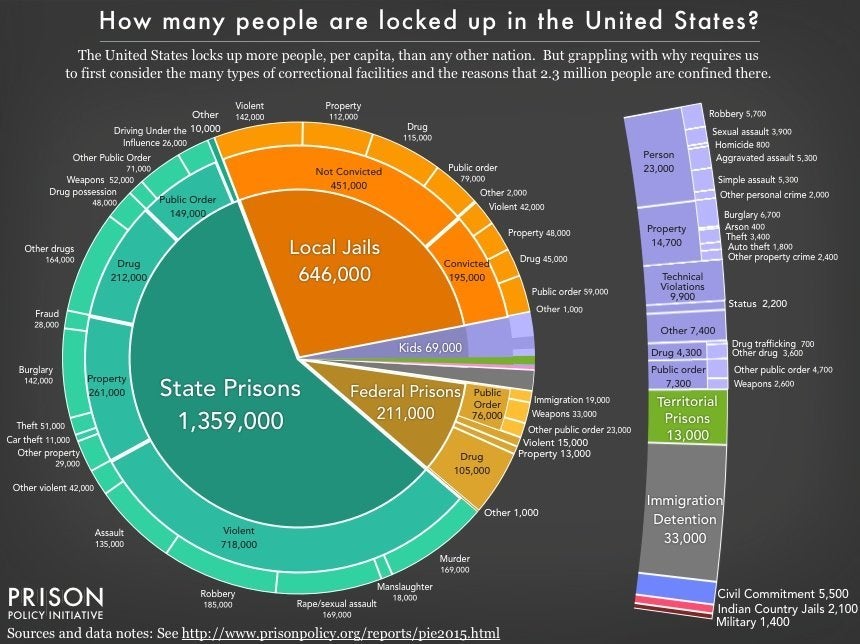
Slavery work and for profit prisons may incentivise to send as many people as possible to prison. It seems a bad incentive if you are looking for a fair justice system.