With plus codes you can both have a short, memorable address and gauge relative distance with other nearby addresses. I'm not sure I can think of a reason to ever use fixphrase or w3w as an alternative to this already existing open standard.
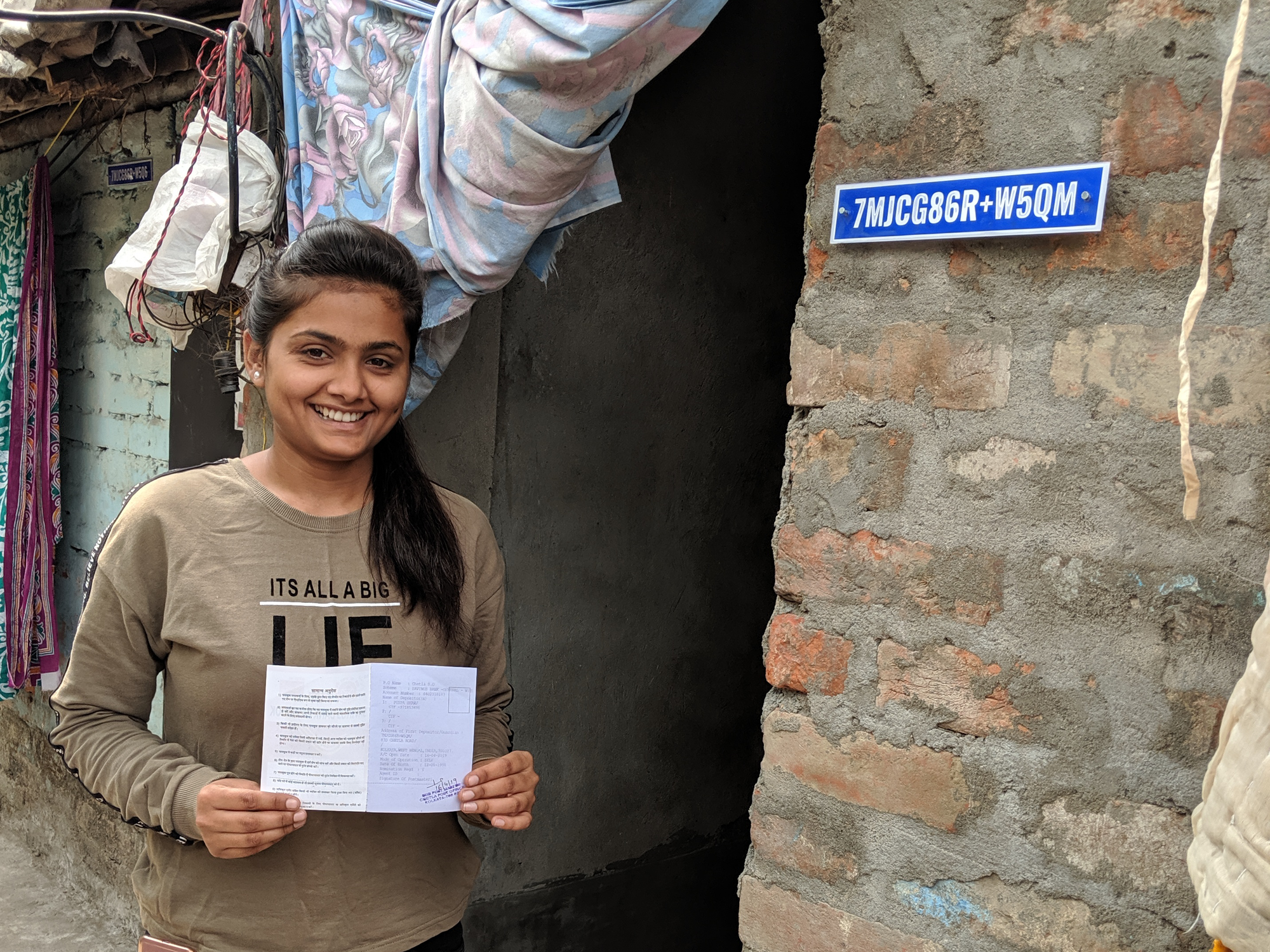
I had to do a double take on the "Powered by Plus Codes" section of that website as one of the pictures they used there shows a girl holding some kind of document in front of a plus code labelled house. Her shirt reads "It's a all a big lie". I thought that was hilarious.
The point of using words is that it should be more reliable when roundtripping via voice or memory. I think it's much easier for people to remember 'reader giraffe suppose advance' than WF24+VMR
Yeah, I agree. I think that what3words hasn't spent enough effort on this, or perhaps is suffering from trying to cram everywhere into 3 words, which means the wordlist needs to be unmanageably large.
Even for my attempt at the problem, I did various experiments on the word list, but an ideal attempt would check for similarity across common accents, etc and I certainly wasn't able to do that.
Having said that, I think it's a valid and realistic goal for good word encoder systems to aim for good roundtripability via voice or memory.
The problem with any system like this is that for it to be useful you can't change it after its launched. Any problems with the word list or location allocation are permanently baked in.
That's not necessarily true. You can make sure your decoding system understands both the new wordlist and the old wordlist but only gives you new encodings based on the new wordlist.
English has suffered the Great Vowel Shift, and has a wide variety of accents. It's a language that has the Spelling Bee, -teen/-ty numbers, -ough suffix, and "ghoti". There are many languages with much more regular, phonetic spelling and smaller variation of accents.
> It's a language that has the Spelling Bee, -teen/-ty numbers, -ough suffix, and "ghoti".
For the second point, -teen/-ty numbers sound different, are spelled differently, and mean different things. How are they supposed to support your point?
For the fourth, it's just false; "ghoti" in the pronunciation /fɪʃ/ does not come close to being valid written English. There is no such thing as syllable-initial "gh" /f/ or syllable-final "ti" /ʃ/.
The -ough suffix is a real case of one sound diverging into two sounds, but that is obviously not relevant to the problem of determining, from the sound of a word, which word you just heard. It comes up in the opposite problem of determining how to pronounce a word from the spelling, which we aren't talking about here.
The spelling bee is a cultural artifact; every language whose writing system is not extremely recent exhibits the phenomenon that the spelling of a word cannot be predicted from its sound. (In China, where spelling is much, much tougher, they don't have spelling bees. They do have traditional dictation exercises.)
The problem with plus codes it they're neither open nor codes. Try taking the alleged decoding algorithm and decode this one straight from Google Maps: "7W87+RRX Odesan, Sør-Sudan"
Did you notice how you can't "decode" the code without looking it up on Google Maps? That's not a location code, that's just using Google Maps.
w3w considers the disambiguity an asset. Almost like a check sum. If you enter an address, and it's in the middle of the Pacific, you know you wrote it down wrong.
Well, you can find CRC collisions too without much work. Doesn't mean they are useless though. As long as they are guarding against error and not malice.
that's an interesting point, but in practice I don't see how it's meaningful. If you write down a plus code and end up in a similar area, you contact the person with the address and figure it out without much issue. If you can't contact that person again, well you're at least most likely to be in the area and can ask around for directions.
with w3w if you can't contact the person with the address again, you've no idea where on the planet this place might be.


With plus codes you can both have a short, memorable address and gauge relative distance with other nearby addresses. I'm not sure I can think of a reason to ever use fixphrase or w3w as an alternative to this already existing open standard.