1. Most of that cost is an apples to oranges comparison as the nuclear plants are required to fully fund decommissioning upfront, whereas dismantling a wind farm (even if just turbine by turbine as they break down) isn’t priced into that alternative. apples-to-apples it’s not that much more expensive upfront cost, and significantly cheaper over 50+ years of operation.
2. Most of the real costs that exist for nuclear are construction. Repurposing coal plants saves a good chunk of that.
Dismantling a couple hundred wind turbines seems like a significantly easier job than dismantling a nuclear power plant. You also don't need state-funded insurance against catastrophic failure for wind turbines. Normal insurance can be bought.
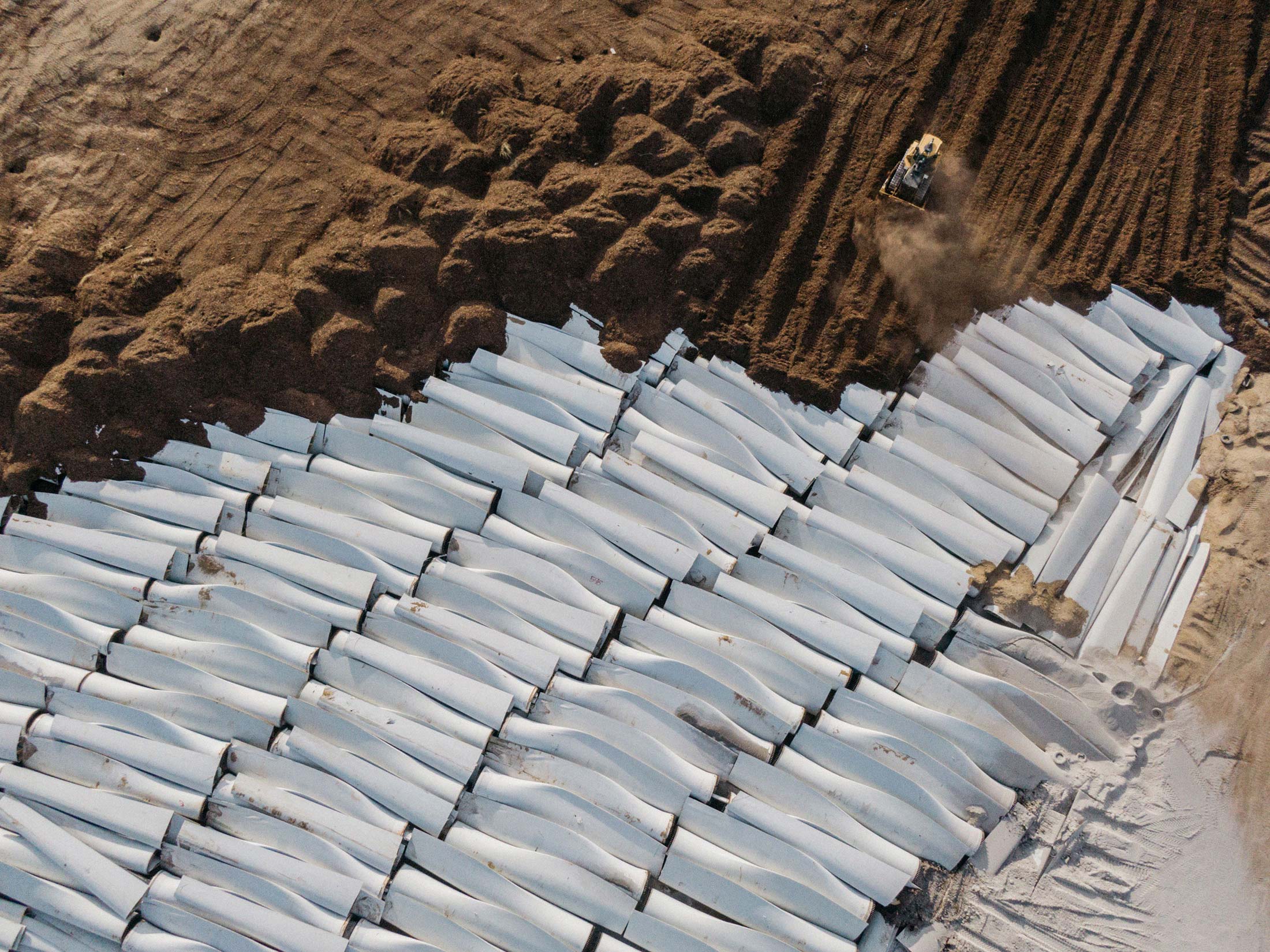
You decommission a nuclear plant only once, after 60-100 years of operation (or even later). You need to replace the wind turbine blades every 15-25 years - the blades could literally fly apart if you didn't. And there's no good way to recycle them, so it goes into landfill. Not great.
Wind turbine blades probably only make up a very small fraction of the nonrecycleable waste we produce. Personally I'm not very worried about them sitting in a landfill somewhere. "Just bury it somewhere" seems to be an acceptable solution for nuclear waste, why not turbine blades?
Because there's already thousands of times more wasted blades (by mass as well as land use) from the little wind power we use now. Also, nuclear "waste" is reusable as fuel for other kinds of reactors, waste is a misnomer.
This is a lie about "low level" waste: all the inside of a nuclear plant that has been in contact with nuclear material is also waste, which cannot be recycled. This is why the decommissioning is difficult. You can take out the fuel rods, but not all the radionucleties in the pipework and those formed by neutron absorbtion.
That waste is not the extremely problematic type with a half-life of billions of years. A couple decades of storages renders it inert.
The problematic waste is only produced by non-breeder reactors that leave 99% of the extractable energy of the uranium unextracted. Breeder reactors would allow mankind to sustain 1,000 times current electricity consumption levels for over a million years with known uranium and thorium supplies, while generating almost zero extremely long-term waste.
Why is a half life of a billion years problematic? The longer the half-life, the less 'active' it is. That aside, in about 5 billion years the sun will turn into a red giant, possibly expanding out behind the orbit of earth until it reaches the orbit of mars. Looong before that there will be many sunstorms torching us.
Or some supervolcano hick-up. Or, or, or, whatever.
Because planning on those timescales is extremely difficult. The storage needs to be made robust to civilizational collapse, civilization forgetting about the existence of the waste, and shifts in tectonic plates.
] Each nuclear power plant has facilities for the conditioning and interim storage of the radioactive waste that is produced during operation. In addition, the ZWIBEZ interim storage facility is located on the site of the Beznau nuclear power plant.
] The Paul Scherrer Institute (PSI) has facilities for the treatment of its own radioactive waste and for waste originating from the medical, industrial and research sectors. This waste is stored temporarily in the Federal interim storage facility on the PSI site.
2) Not all of it is spent fuel that can be reprocessed
] Radioactive waste from nuclear power plants is in the tens of thousand tonnes in Switzerland.[22] Its management is the responsibility of the producer.[23] Up until 2006, processing of nuclear waste was mostly done overseas.[24]
4) I don't believe Switzerland mines and produces it own fuel rods, so the radioactive waste during that production would not be stored at Zwilag
> "Because there's already thousands of times more wasted blades"
Nonsense. You need to consider that the entire plant ends up as waste when it's eventually decommissioned.
Wind turbine blades typically weigh a few tonnes each. Up to around 10 tonnes for the very largest ones. Meanwhile, building a new nuclear power plant (Hinkley Point C in the UK) takes 3 million tonnes of concrete and 230,000 tonnes of steel.
All the wind turbine blades in the entire world would only add up to the waste of one or two nuclear plants!
Mass and volume conveniently omit how careful you have to be when handling the waste. I thimble full of radioactive waste in the wrong spot can be pretty bad. Turbine blades on the other hand are not more dangerous than normal household waste.
No, it's really not that hard. My country's nuclear waste sits in containers placed outside for decades. Even shooting the container with a machine gun wouldn't produce any danger.
Not many nuclear plants last for 60-100 years. Most existing ones have an operational life of about 40 years. Those that run longer have invariably received an extensive (and expensive) mid-life refurbishment.
Then they are left in a shutdown, de-fuelled state (safe storage) for 60 years or so before they can be safely dismantled.
This whole process is very expensive, in part because you have to pay to manage and maintain the site for such a long time.
Decommissioning all the UK’s existing civil nuclear sites is estimated to cost taxpayers over £132bn, and the work will not be complete for 120 years.
Sure, refurbishment is necessary - my country just went through the process after 35 years of operation of the oldest reactors, now it's certified for 50 years more and another refurbishment is expected after that - not decommissioning. It wasn't that bad. We pay more for maintenance of the little wind power we have (less than 15% of our energy production on windy days) than we pay for nuclear reactor refurbishment (>30% of our baseload, works all day and night, all year).
The estimated costs for energy from refurbishing France's nuclear plants till 2050 is 15% higher than building new offshore wind today. And that's EDFs own estimate. Onshore wind and solar are already cheaper than offshore and all are predicted to continue to get cheaper.
> The estimated costs for energy from refurbishing France's nuclear plants till 2050 is 15% higher than building new offshore wind today. And that's EDFs own estimate.
Do you have a link to that? Are we talking same effective generation capacity?
> As a starting point: it is undoubtedly true that industrial-scale nuclear power, as built in advanced Western countries in the 1970s-1990s, has provided, and still provides, cheap power, even taking into account the uncertainty on the cost of both long term waste storage and dismantling of the plants. And, until recently, low carbon alternatives like wind and solar were between “somewhat” and “a lot” more expensive. To a large extent, French skepticism about renewables over the past 20 years was not unreasonable given that the country did not have carbon-spewing (and otherwise polluting) coal-fired plants to replace - it had and has a low-carbon and cost competitive power sector.
> Le coût complet économique du parc nucléaire en exploitation, incluant
le Grand Carénage, s’élèvera environ à 55 €/MWh avec une durée
de fonctionnement de 50 ans, en moyenne sur la période d’ici 2025, un prix
permettant aux clients de bénéficier d’une électricité compétitive (Source : Cour
des comptes).
First, why does he discard the idea that nuclear power plants can be fully financed by the state, as RTE assumed in their report (in which nuclear came out slightly cheaper)? EDF is getting renationalised currently, and honestly financing from private markets something as expensive, crucial and with such a long life doesn't make much sense. A Nuclear Power Plant can operate for many decades (50+ years easily), so even if it breaks even in 40 years, that's completely acceptable for a state and it's budget. Private investors, and private financing, would like returns much easier.
Second, the elephant in the room - not all MWh are equal. When they are produced, and the load factor. Onshore wind, which the author mentions as cheaper, doesn't produce at 100% all the time. Solar is even worse, because at best it could produce energy during half the day. Both are subject to weather, like the few months of clouds and low winds we had last autumn all across Western Europe. To even them out, you either need luck, or storage, lots of it. Price that in, over a 50 year lifespan, and i very much doubt it will come out cheaper.
He doesn't claim the state funding Nuclear is a bad idea. He actually claims they'll increasingly have to.
What he's complaining about is the same WACC being used for nuclear and wind, when the wind one is much higher than reality, because they are so predictable in terms of how long and how much they take to build.
And even with that (and all the other advantages he's willing to give to nuclear, the French still can't make a good case for nuclear.
He covers the "not all MWh are equal" thing near the start and correctly counts that as a problem for nuclear, not a benefit.
> Its generation profile, “baseload” (i.e. constant production at full capacity) does not actually correspond to what the market demands, and does not easily provide for flexibility, reliability or load following. The fact that our systems have been built around baseload (nuclear and lignite) has pushed us into ways of thinking that are not actually useful - baseload is not enough, and it’s not that useful
It’s worth remembering that the “baseload problem” of nuclear and the intermittency problem of renewables both have the same solution: storage technologies.
> "Sure, refurbishment is necessary - my country just went through the process after 35 years of operation of the oldest reactors, now it's certified for 50 years more"
Canada? It's not quite adding 50 more years: it adds around a 30-35 year life extension to each refurbished reactor, so the reactors currently being refurbished will be certified through to about 2055. And the refurbs aren't exactly cheap: they replace all the major reactor components, and cost a significant portion of the price of a new build.
Nevertheless, it does seem better to extend the life of existing sites where it's possible to do so. It speaks highly of the CANDU reactor design that this has been possible! Most other country's reactor designs haven't been so successful in this aspect.
> "We pay more for maintenance of the little wind power we have than we pay for nuclear reactor refurbishment"
The wind turbines outmass an equivalent capacity of nuclear reactor but not by a huge factor (about 2W/kg total or 8W/kg of not-concrete vs 15 or 30). The blades are a tiny fraction of that and the rest is fully recyclable. 100t of turbine blades per century per MW is at least as easy to handle as 200t of low grade nuclear waste in the form of radiation shielding and various other neutron poisoned materials.
Wind turbine blades are also pretty damn inert. We could literally just dump them into a giant pile in arizona for centuries with no issue, paying them a pittance for the privilege. Getting pissy about inert trash is silly. Maybe they shed microplastics? Oh no, now the useless desert sand is full of microplastics that it was probably already full of because of decades of plastic use.
I'm also certain they'll see down-cycling. 10t of the strongest and lightest materials on earth is by no means worthless even if it's anisotropic and needs an ultrasound before relying on it.


2. Most of the real costs that exist for nuclear are construction. Repurposing coal plants saves a good chunk of that.