**DISCLAIMER: The numbers don't add up, someone's numbers are wrong see Jesson's child comment
>US is below the mean for average mathematical performance and this isn't helping.
This depends on whether or not you control for race [0]:
- Asian (556)
- White (531)
- Hispanic (481)
- Black (448)
- Mixed Race (501)
Despite the euroworship in this thread, White-American and Asian-American students outperform Europeans and Asians, respectively (although I don't have data that breaks down those countries' scores by race, so take this with a grain of salt). Quite interesting how people in this thread (whom I suspect are mostly white- and Asian- American males given the hours/site) are talking about how bad the US education system is and how their European friends were all learning Riemann sums in kindergarten.
The system is only failing black and hispanic students. Really tough problem to solve, but the data does not support the conclusion that the American maths education system is "behind" or "failing" as a whole. I would also like to see the scores stratified by income, which my linked paper did not provide.
Yes I’ve seen these statistics a number of times and it really goes against so much of the “lol Americans are bad at math” meme all over the internet.
America is a society of disparate cultures, regions, communities, and outcomes (often in the same cities) that is far too fine grained to reduce it to generalities (with a few exceptions such as heavily nationally influenced/consistent things like health care insurance, defence spending, Wall St/banking policies, etc).
Some people try to minimize it all to “class” like they found some Pandora’s box for all of life’s problems but that’s just as often flawed as any other generalization.
Poverty is different from class. The poverty achievement gap is 2x the race achievement gap. The following article describes a study that claims that poverty “entirely accounts” for racial gaps.
I can't read the article, but does it control for race within poverty? A lot of poverty conclusions are confounded by race, yet even within poor cohorts you will find significant disparities by race. For example,
> Whites from families with incomes of less than $10,000 had a mean SAT score of 993. This is 130 points higher than the national mean for all blacks.
This chart visualizes that point: SAT scores of whites in the poorest segment exceed those of blacks from all but the richest segment, and Asians exceed them no matter their income:
I'm not sure you read your own source. It seems you just cherry-picked a couple of passages that support racist views and decided to ignore everything else.
Your own source mentions not only the correlation between income and SAT scores, but it also points out a link between quality of the education services provided to some communities and social pressure. It's also telling that the outliers are explained in a way that boils down to "they succeed in spite of everything we throw at them".
It seems like you’re projecting racist views onto the parent comment. It never discounted the possibility of other race-related factors being the cause of the achievement gap, it was just challenging whether all of it could be accredited to wealth disparities.
> It seems like you’re projecting racist views onto the parent comment.
What? OP's argument was purely race-based. OP made absolutely no point other than underlining race-based correlations. If you remove all race-based remarks from OP's post, nothing is left.
> It never discounted the possibility of other race-related factors (...)
In your own words, you describe OP's post as focusing on "race-related factors", and even then you try to accuse those who point that out of "projecting racist views"?
For example, the differences in scores that is not explained by income could be caused entirely by disparate treatment of children by adults based on the child's race. That would be a race-related factor.
1. I'm pointing out that poverty and racial factors often confound each other. The comment I was replying to made it seem like racial effects disappear when you control for income. If you care about racial equality, then I would think it's in your favor to argue against someone who says racial effects don't exist.
2. It's not racist to point out that certain outcomes correlate with race.
Sure but I’d still rather not use that as the defining metric. Unless there’s some evidence throwing money at public schools in lower class neighborhoods is the solution to the problem. Every time I’ve looked into that subject in the US the biggest complaint by the teachers on the ground, in those neighborhoods, say they feel like they need to be teacher + daycare + parent for a subset + law enforcement officer etc. I grew up in a small town in Canada with mostly poorer lower/lower-mid class student but my school never had such an obligation (not overt expectation) to be parental replacements/invested psychologist/serious enforcers.
At a pretty sudden level focusing on education alone is the fault not the solution. When teachers actually get to be teachers it seems US schools do just fine or better than most of the world (not simply comparing to subsets of small homogenous European countries).
It may point to issues that are not race or class but structural in a way that suggests deeper issues. Indeed “throwing money at schools” is unlikely to improve situations at home. But poverty has a big effect on kids ability to learn. It isn’t just money—poverty is a multidimensional deficit in wellbeing. Kids who are stressed, abused, neglected, etc — it’s hard for them to learn effectively.
> say they feel like they need to be teacher + daycare + parent for a subset + law enforcement officer etc. [...] When teachers actually get to be teachers it seems US schools do just fine or better than most of the world
Some of it is definitely because of the lack of a support system at home (poverty, absent fathers...). But I think a lot of it boils down to culture. And if we're to look at it based on race, White Blacks and Hispanics could all improve.
There's a lot of families where school is seen as unimportant, and where education isn't as valued as it could be.
> Unless there’s some evidence throwing money at public schools in lower class neighborhoods is the solution to the problem. Every time I’ve looked into that subject in the US the biggest complaint by the teachers on the ground, in those neighborhoods, say they feel like they need to be teacher + daycare + parent for a subset + law enforcement officer etc.
You wrote this down yourself, and you still didn't get it?
The article and study are a lie. It leave out Asians because when you them then poverty stops explaining the achievement gap. They are blatantly cherry picking their data.
Which part of the article and study are a "lie"? Hand-waving wealth as being irrelevant to achievement by highlighting Asian success ignores other resource-related factors.
One easy factor to distinguish is the percentage of immigrants in the Asian population."Around six-in-ten Asian Americans (57%), including 71% of Asian American adults, were born in another country"[1]. The background of a lot of these immigrants made them well-qualified to succeed despite their American socio-economic status on arrival [2].
If you compare that to black people in America, many of who's ancestors were brought here in unsavory ways, only "One-in-ten Black people in the U.S. are immigrants". There's no comparison of the ingress of black people in this country when compared to Asian populations, and consequently we don't see the same US immigrant selectivity boosting the numbers of an already disadvantaged race in the same way.
This is not to say that culture has no effect, since I doubt the high participation rate of Asian children in after-school tutoring necessarily hurts those children [5], but it may represent a smaller part of the overall picture than most people think. Choosing minority races from opposite sides of the success spectrum and underlining some of their differences in a data-driven way may help us better understand and combat the problem of equity.
> The background of a lot of these immigrants made them well-qualified to succeed despite their American socio-economic status on arrival
Immigration filtering explains a lot, but the general trend holds even for subgroups that aren’t subject to those filters.
Some Asian groups, like Vietnamese, came to the US as refugees, not skilled workers. In 1980, poverty rates among Vietnamese people were among the highest off any ethnic group. Today, Vietnamese have similar income levels to non-Hispanic whites.
Moreover, the kids of poor Asians have much more income mobility than the kids of similarly placed whites. Asian children who grow up in the bottom 20% of the income distribution have a 25% chance of ending up in the top 20%, compared to an 11% chance for white kids. These poor Asians are typically in America as a result of family reunification. Thus, neither the kids nor the parents are subject to filters such as H1B job requirements.
How do you escape the conclusion that culture makes the difference?
Your examples are two opinion pieces that seem to not actually understand what critical race theory even is. Asians aren't a problem for the people who study critical race theory, it's really only a problem for people who have no clue what they're talking about.
Asians and Hispanics create two problems for critical race theory, one pretty easily fixable another less so.
1) CRT, originally developed in the 1970s, generally assumes a black-white dichotomy. Insofar as it addresses Hispanics and Asians, it does so by putting them in the “black” column—victims of oppression in a system of “white supremacy.” But that’s plainly not true. If you look at the statistics, the closest comparison to the experience of poor Latino and Asian immigrants is poor white immigrants like Italians. They are achieving economic parity with whites within a couple of generations. They don’t face persistent multi-generational gaps like black and indigenous people do.
2) Asians (and to a lesser extent Latinos) broadly do not share the political premise of CRT: that our economic and political systems are tainted by “white supremacy” and must be fundamentally changed. That flows partly from culture. Animosity between different ethnic and cultural groups is widespread in Asia and Latin America. Generally speaking, it’s perceived as bad manners, not an existential threat to prosperity. My parents never talked to me about racism growing up, and I suspect that’s pretty typical in Asian and Latino families. By contrast, I think such conversations is very common among black Americans. That attitude is reinforced by the economics. The experience of the overwhelming majority of the kids of Asian and Latino immigrants is closing the gap with whites as compared to their parents. The notion, fundamental to CRT, that non-whites can only make progress through coordinated changes to the system isn’t compatible with their lives experience.
> Insofar as it addresses Hispanics and Asians, it does so by putting them in the “black” column—victims of oppression in a system of “white supremacy.”
Can you point to CRT works that do this? I'd like to read them.
Sure, look at the California Model Ethnic Studies Curriculum: https://www.cde.ca.gov/ci/cr/cf/documents/esmcchapter4.pdf. It takes Kendi's black-white oppressed-oppressor dichotomy, and simply shuffles asians into the oppressed, non-white category.
Lesson 14:
> It presents a false narrative that Asian Americans and Pacific Islanders (AAPIs) have overcome racism and prejudice. It glosses over the violence, harm, and legalized racism that AAPIs have endured, for example, the 1871 Chinese massacre in Los Angeles, the annexation of Hawaii, shooting of Southeast Asian schoolchildren in Stockton.
Lesson 16:
>Chinese Americans are Americans and have played a key role in building this country. Had it not been for this workforce, one of the greatest engineering feats of the nineteenth century (the first transcontinental railroad and others that followed), would not have been achieved within the allotted timeline.
It's a projection of how CRT views black history, where ethnic identity is defined in terms of historical discrimination. Meanwhile, do kids of German, Italian, or Irish descent in California learn about the intense racism their ancestors faced when they came here? Of course not.
What's especially galling is that German, Italian, and Irish Americans are at least the descendants of people who faced intense discrimination when they got to America. Meanwhile, virtually all Asian Americans are descended from people who came here after 1950, and mostly after 1990. California is teaching Asian kids to identify with historically discriminated people who aren't even their ancestors.
> What's especially galling is that German, Italian, and Irish Americans are at least the descendants of people who faced intense discrimination when they got to America. Meanwhile, virtually all Asian Americans are descended from people who came here after 1950, and mostly after 1990. California is teaching Asian kids to identify with historically discriminated people who aren't even their ancestors.
Especially for Asians, a lot of them came to America fleeing persecutions in their home countries... from other Asians! I'm thinking Vietnamese refugees fighting against the communist regime and people from Hong Kong fleeing the Chinese Communist Party at home.
The CRT worldview makes slavery the central event of history, and oppression by whites the central theme. That’s what’s going on in the Nikole Hannah-Jones quote above. How do those folks perceive immigrant groups that come here and tell their kids to shut up and work hard? I think that leads straight to the idea that Asians are complicit in “upholding white supremacy.” And even white people like John Oliver get in on that narrative.
Of course from our perspective we are just raising our kids according to our culture. In broad strokes, both east and south Asian cultures tend to be deferential to authority and emphasize an internal locus of control. If you ask my mom why bangladesh is poor, she’ll point to corruption and other moral failings, not British colonialism. Whether that is accurate or not, that’s completely at odds with the CRT worldview, which emphasizes an external locus of control—blaming oppression by whites for everything.
Nikole Hannah-Jones is a journalist, not a Critical Race Theorist. Find a better descriptor for this (perhaps prevalent) "worldview" than "the CRT worldview". Prompted by a bunch of unproductive discussions like this one, I took some time and actually read a bunch of CRT journal articles, and none of these discussions intersect what actual CRT work says. That may be as much a fault of popular culture and pop sociology as it is HN's, but either way, it's annoying.
It is easy to make a case that Nikole Hannah-Jones essentializes the transatlantic slave trade. But it is unreasonable to generalize from Hannah-Jones to a whole field of study without evidence.
Nikole Hannah-Jones has a degree in African American Studies, so I think the label is perfectly apt. It's like "supply-side economics." It's a useful label for political ideas that are adjacent to an academic theory of the same name.
Hannah-Jones has a bachelors in history. My sister has a degree in Russian Literature. But she's a lawyer, not a literature critic. Hannah-Jones is not a Critical Race Theorist. That is an actual thing, and your education brought you closer to it than Hannah-Jones' did.
https://profiles.howard.edu/nikole-hannah-jones (“Hannah-Jones holds a Master of Arts in Mass Communication from the University of North Carolina at Chapel Hill and earned her Bachelor of Arts in History and African-American studies from the University of Notre Dame.”).
The ship has sailed on trying to limit “CRT” to its original academic meaning. People needed a word to refer to the ideology that had suddenly become prominent in public discourse, and “CRT” won. See: https://freddiedeboer.substack.com/p/please-just-fucking-tel...
No, I don't think I will defer to the culture warrior Freddie deBoer on this. Hannah-Jones is a journalist, not a theorist or an academic, and words mean things.
DeBoer is just describing the phenomenon: We needed terms for ideas which are increasingly prevalent but resist labeling. So we appropriated “CRT” for that purpose. Words mean things, of course, but they can mean multiple things according to popular usage. “Nicole Hannah-Jones thought” is the dominant meaning of “CRT” today. Almost nobody means to refer to some obscure branch of legal academia.
I'd be much more amenable to that if the people "appropriating" terms like CRT weren't doing so to tar actual CRT theorists, but they are, so I'm not at all amenable to it in this case.
If you don't agree with using the term "CRT" to label the kind of views espoused by people such as Nikole Hannah-Jones – is there another label you'd support instead?
It depends on how specifically Hannah-Jonesian the critique is. Is the issue here 1619ism? That's a fair label for what she represents. Is it more broadly Kendi-style "anti-racism"? I think if you put scare quotes around "anti-racism", that's fine too. Is it political correctness? The modern term for that is "wokeism" (no quotes needed).
"Woke" is also an appropriated term. But it's original meaning is actually pretty close to its current meaning; I remember a Lexicon Valley episode where one of McWhorter's academic guests observed that "woke" is what you'd call your crazy uncle at Thanksgiving who thought the flouride in your toothpaste was a government mind control system.
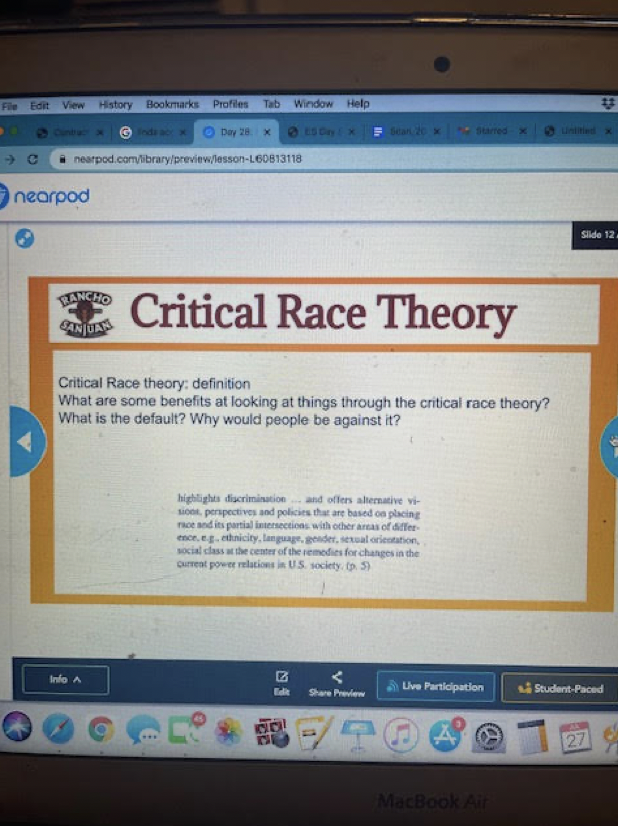
Did you see this article containing screenshots of an ethnic studies course at a California high school, with slides about "Critical Race Theory"? https://reason.com/2022/01/31/critical-race-theory-taught-in... Some might accuse the "whistleblower" of being a "grifter", now that she's swapped her teaching career for the conservative speaking circuit – but, I doubt the screenshots are faked, because if they weren't real, surely the school would have come out and said that to rebut her criticism of them.
Maybe that course is an outlier, but it does serve as a counterexample to the narrative that "CRT is not being taught in K-12 schools". But, if they are teaching CRT (even by name) in some schools, how close is the CRT they teach to the original academic theories? Given my personal experience at how badly schools can mangle things – I still remember the bizarre errors in my high school computing studies textbook, and the interactions I had with teachers in which I tried to explain why the textbook was wrong, and they couldn't understand anything I was saying – it wouldn't surprise me if high school CRT had little in common with the scholarly version.
But if that's true – wouldn't it just show that critics are not the only people appropriating the term "CRT"? In which case, if people on "both sides" are appropriating "CRT", how is its appropriation any worse than that of "woke"? If you'll accept the appropriation of the latter, why refuse it for the former? With "scare quotes", if need be.
Can you be more specific about which slides you want me to respond to? CRT does have a position about what nominally race-neutral school board policies mean when reframed through race. That's unsurprising, because since Buchanan v. Warley, most racial policy in the US has been nominally race-neutral.
I don't think CRT should be taught to grade schoolers. It's complicated and all you can give students who barely understand civics is a bunch of fortune cookies.
Neither slide contains much content, so they don't really tell us how Rancho San Juan High School (Salinas, CA) has been teaching Critical Race Theory – but they are evidence that they have been teaching it.
Were they teaching it accurately? We don't have enough information to say. But, it wouldn't surprise me that, even if the original scholarly theories have some legitimacy, a high school tasked with teaching them would mangle them into something else entirely.
I don't dispute that there are misguided K-8 schools that have been teaching CRT, or what they think CRT is. They shouldn't be.
There would be a more compelling argument here if either of those slides said something outré. But neither does, so I don't know what I'm supposed to do with this.
> I don't dispute that there are misguided K-8 schools that have been teaching CRT, or what they think CRT is. They shouldn't be.
Okay, that was my whole point though – "CRT" has been appropriated to mean something different from the original academic theory – and not just by the "anti-CRT" crowd, by "pro-CRT" folks too. So why not just accept that "CRT" now has two meanings, the original scholarly meaning, and a colloquial meaning, and they are different, even though the later grew out of (distortions of) the former?
The appropriation of "CRT" isn't really any different than the appropriation of "woke", which you seemed more okay with.
I put a lot of work into my citing the data sources from my comments so that the numbers can be vetted by the institutions they were reported by. Do you have any sources you can reference that show where you get your numbers from?
But those numbers are a lie, American whites scored 503, just look at the report page 34, it clearly says that white Americans scored 25 points higher than the average 478 at math. 478 + 25 = 503.
He must have taken the wrong graph.
Edit: Anyway, 503 is pretty average for Europeans, so it means that Americans are pretty average at math, as you'd expect for a large country. So it is still proof that Americans aren't bad, they are typical.
Fair enough. Although being the median with such a large country is still pretty divergent from the popular narrative I was comparing to. Those sorts of generalized nationwide numbers wasn’t my point anyway, rather proper data analysis and putting data into the wider context of the various communities/finer demographics/etc leads to far more useful conclusions than national level ones alone.
Similar to critiques of the GDP as a metric for success.
It’s not surprising the default critique on Reddit/Twitter is always using some European country with a homogeneous culture and a small population centered around ~2-3 major cities at most vs the entire US.
> Those sorts of generalized nationwide numbers wasn’t my point anyway, rather proper data analysis and putting data into the wider context of the various communities/finer demographics/etc leads to far more useful conclusions than national level ones alone.
What conclusions would those be?
> It’s not surprising the default critique on Reddit/Twitter is always using some European country with a homogeneous culture and a small population centered around ~2-3 major cities at most vs the entire US.
If you'd prefer you could compare whatever nation you'd like with individual US states. You have plenty of US states to pick and choose from.
Regardless, I don't see this sort of statistics rigour when comparing the US to "Europe" as a whole, in spite of the heterogeneous nature of the whole continent (some countries even have regions where people speak entirely different languages) and the fact that the population of "Europe" is well over twice that of the US.
But I guess the point might just be to shut down discussions to avoid conclusions and introspection.
There is an entire education consultancy industry whose financial viability depends on convincing people that American public education is in some kind of crisis when it isn't; it's actually a little above average, as we see.
Now, would I like it to be way above average? Sure, and I'm willing to make the public investment to make that happen. But starting from the premise of "we're failing miserably" is going to lead to the wrong conclusions.
America also accepts way, way more immigrants than any other developed nation. Japan? None. Norway? Zilch. Netherlands? Come onnnn. They get handfuls but as a percentage of population the USA takes in boatloads and bus loads of immigrants every month.
When you look at statistics that say the US is lower in this or that, remember that America takes in millions of dirt poor immigrants each year, and their circumstances skew the numbers. However they get assimilated and integrated, and a generation later their kids are going to the Ivy League and starting businesses.
I'm not sure the data matches that line of reasoning. Looking at number of immigrants per capita for various countries, the US is beat out by some of the countries you wouldn't expect from your conclusion. Notably Australia, Switzerland, New Zealand, Canada, Sweden, Austria, Iceland, Germany, Ireland, Belgium, and Norway all have more immigration per capita than the states it seems. https://worldpopulationreview.com/country-rankings/immigrati...
An Austrian who immigrates to Germany or even a German (or other EU national) who immigrates to Switzerland has a very different experience, both in terms of legal hurdles and likely relative earnings than someone immigrating from Latin America to the US.
How about if we look at immigration into the US as a whole vs immigration to the EU as a whole? What do the numbers look like, then?
The US tech obsession with degrees is stupid and self-defeating. You'll regularly see ads for a web programmer requiring a BS in computer science. Somebody with a BS in comp sci should be able to write a (very simple) operating system, which is not what you need. It's even weirder because some jobs simply require any bachelor's degree, whatsoever, which is how I became a sysadmin after being a classics major. This is just explicit class gatekeeping.
If anything I feel like the US is an outlier in qualification requirements. It feels like every European country requires degrees for every single tech job, whereas in the US you can get by without one or just a BS. The amount of jobs I have seen in the EU that require an MS even though it really shouldn't is insane. I think every single technical ESA role requires an MS at minimum, whereas you can easily work at NASA with just a BS, which doesn't really make much sense.
Also you can still go to community college/a state school to get a BS? Or join the Army or something, take a low risk MOS, get them to fund your bachelors. The US is way less class prohibitive and has far more class mobility than the EU as a whole so I'm not sure what you're talking about.
The US has significantly lower social mobility than most of Europe, though I think people kind of ignore that and pretend the opposite is true.
It's a lot easier to get in to college in the US than in most of Europe, but it costs a whole lot more (like requiring a degree in the first place, it's a kind of social gatekeeping). I think nowadays like 60% of high school grads attend some amount of college, but only about half of those get an actual degree.
Are you serious? There are quite a few more developed nations other than the three you've listed (and I'm not even sure if the claim is accurate for all three, when adjusting for size).
Just last year, Germany has accepted more than a million Ukrainian immigrants – at a population of under 100 million. Yes, exceptional circumstances, but there have been a lot of these in the past decade (consider e.g. the Syrian war). And the number the US accepted in the same year? Just short of 2000. Yes, two thousand, not two millions – at four times the population.
Looking at the statistics, the balance is something like half a million in net(!) arrivals per year in the last decade. (I couldn't find comparable numbers for the US, but granted green cards seems like a reasonable proxy, and that's also less than a million per year, and that's not even accounting for people moving away.) And if you look at the larger EU, the "more than any other developed nation" claim completely falls apart.
The US also gets to cherry-pick immigrants based on skill to a much larger extent than the EU does due to geography alone (requesting asylum generally requires physical presence, and the EU's land and sea borders are a lot easier to cross).
Pretty intellectually dishonest to ignore the massive amount of “undocumented” immigration happening in the US. Nobody absorbs more immigrants. Full stop.
I'm willing to believe that that number is (much) larger than granted green cards or visas – but are there any reliable estimates? Otherwise it's just a baseless claim.
One number I've found puts the estimated number of unlawful entries to the US per year at under 100k, for a total population of around 10 million. The EU sees around 2.5 million immigrants, vs. around 1.5 million emigrants, per year.
GPs claim of "millions of dirt-poor immigrants per year" skewing the numbers doesn't seem realistic to me.
Border patrol has averaged around 200K apprehensions per month for 2 years now at the southern border, that doesn't even account for the people they didn't apprehend. Not sure where you got the 100K annual number but it isn't even close to accurate
Well the question is what is the number who make it through? The number captured isn't relevant. If they captured 100% then the undocumented immigration number would be 0. Then we also need to know how many self-deport back over the border.
It's estimated to be net negative (more people leave illegally than enter illegally). It peaked late in George W Bush's 2nd term and has been falling steadily ever since, crossing the zero point some time during Obama's admin.
It's an entirely made-up "crisis", but a reliably effective one politically.
Not to mention Obama deported almost 1% of the entire American population (some 2.5M between 2009 and 2015) - more than any other president either in actual numbers or as a percentage of the population.
I mean, no. Net illegal migration has been negative since Obama's second term. It's basically an entirely made-up "crisis" and has been for a decade now.
> Yes I’ve seen these statistics a number of times and it really goes against so much of the “lol Americans are bad at math” meme all over the internet.
I never came across any of the sort.
What I come across frequently is the extension of the American exceptionalism mindset that leads some US natives to believe they are exceptional at math in spite of evidence failing to support their exceptionalism views.
> America is a society of disparate cultures, regions, communities, and outcomes (often in the same cities) that is far too (...)
I also see this all too often: the follow-up to the exceptionalism mindset failing to support their beliefs in a rational basis, and proceeding to cherry-pick subsets that suit their exceptionalism views.
It's like claiming that Americans are all tall athletic and exceptional basketball players, and supporting that exceptionalism view by pointing out that Michael Jordan and LeBron James are US citizens. Meanwhile, ignoring that the average us citizen might have more in common with Danny DeVito.
The US population is over 330M people, and its an unrivaled economic and technological powerhouse. Of course you can find hundreds of exceptional individuals. But being able to find a champion among the masses is not the point of a statement like "Americans are good at math". Baselines matter a lot, and even you admit that the US does not look great by attempting to cherry pick your way out of that.
Other societies are also societies of disparate cultures.
Most other societies also don’t tend to have every group at average, but some groups above average and others lower.
If you break other societies with higher average scores down by groups along fault lines in those societies, the top groups in those societies will also be doing much better than the bottom groups, and considering they have higher average scores, the top groups will likely be doing better than the top groups in the US.
> America is a society of disparate cultures, regions, communities, and outcomes (often in the same cities)
There are cities in Europe with histories spanning thousands of years, but were apart until only 30 years ago. There are countries with multiple ethnicities, multiple official languages.
Those numbers doesn't add up, USA average was 478, how could whites that are a majority score all the way up at 531? There aren't enough black people to drag 531 down to 478, and only black people are below average here.
Edit: Yes, look at page 34 in that report, it says that white kids scored 25 higher than average, so 503. Where did you get those numbers from, those are wrong.
Does anyone else feel weird about comparisons that match a subgroup of people in the US against whole continents? Why is it normal to smash all the countries of a continent into one? What “asian” or “European” student is making it into these standards? The ones with money to come to the US and be surveyed?
1. When people compare with “Europe” they usually mean western and northern Europe. Wealthy democratic countries that were NATO members or aligned during the Cold War.
2. These countries pretty much all (to varying degrees) have a strong social democratic movement that has been able to set policy during the 20th century, resulting in fairly uniform (compared with USA) support for universal education, healthcare, and other things Americans can’t take for granted.
There is huge variation within Europe for sure, but western/northern european countries do largely cluster together when looked at the world as a whole.
totally agree with you. was just pointing out a statistical quirk I thought added value to the discussion.
I'll even retract my point that the US maths education system isn't failing as a whole. When two demographics (30% of the country and growing) are being left behind by the system, then the system is failing as a whole. I really hope to see this change in the future.
>Really tough problem to solve, but the data does not support the conclusion that the American maths education system is "behind" or "failing" as a whole.
Wait, what? That is exactly what it means. If the groups that are least likely to get external support (ie a tutor, prep, whatever) are under-performing that implies the _standalone_ system is broken. Sure, it is not so broken that it can't be patched with outside aid, but that is true of many things we consider "a failure."
This is akin to saying "Of course my car can get across the country. All I need is the occasional tow-truck, you know, for when it overheats."
>If the groups that are least likely to get external support (ie a tutor, prep, whatever) are under-performing that implies the _standalone_ system broken.
Is there reasonable evidence to show that whites and asians receive "external support" at a rate high enough to convincingly explain a 50 to 100 point disparity on this test?
I only skimmed it (read the abstract, checked the graphs, reviewed what stuck out as I scrolled), but quick take aways:
(1) The # of private tutoring centers has tripled to 10k since 1997!
(2) The utilization of the _new_ tutoring centers is primarily by the wealthy (which obviously skews white). In fact, utilization of private tutors by low income folks has gone down in the same period.
(3) They have a section summarizing how Asian-American utilization of tutoring center is high. They even summarize/mention other work that implies tutor usage as primary factor for the high test scores of Asian American students.
I'm not sure how comfortable I am with the second-half of that last point, but finding information from a credible source (Harvard/BU/Brown) wasn't hard.
Controlling for race is stupid and is the source of many of our problems. One should control for socioeconomic factors instead such as family income, whether both parents present, parents’ education.
Outside of the funding issue, most of this comes down to socioeconomic status and cultures of ethic groups. For example, a student in a wealthy household might be given support and the space to not have any other responsibility outside of academic achievement while a student in a lower income household might be expected to contribute to their household by doing more domestic chores and child/elder care. The student in the later situation will obviously have less free time for studying but, perhaps the more damaging aspect, may also be less engaged at school because they already have a mountain of responsibilities at home.
That's undoubtedly true, but time alone isn't enough. Achievement in poorer schools is lower as well; in some schools the only math that students really care about is decreasing their odds of being assaulted between classes, and doing well in class (esp math) isn't helping those odds
I don’t think your realize just how out touch you sound. If you grew up in a well-off family where a traditional work ethic is highly valued, I can see how easy it is to arrive at a simplification like this. Getting a menial free lunch does not fix the other problems a student may face when going home, whether that be the parents not able to feed their children properly or maybe they are in an overcrowded house with no space of their own. This family may not have access to health care outside of the most basic of services and similarly, maintenance on their vehicles because they can’t afford that and to eat that month.
Maintaining government benefits quickly becomes a full time job because of arcane requirements written by uncaring people. Those in poverty might find themselves disincentivized from seeking higher paying work due to the “welfare cliff” where once the make over X amount, benefits start to go away. In some cases, if they suddenly make nothing (as if they’ve just lost a job or had hours cut), healthcare benefits are yanked away just when they need it most.
It’s very easy to see this as a moral failing, but if you’ve not lived through this situation, you cannot possibly understand the toll that poverty takes on you both physically and mentally. The truth, like with most things, is more complicated.
IF their parents filed a bunch of paperwork--which presupposes the time, literacy and desire to do so. Children don't get to choose their parents.
This is one of the reasons why making school lunches a standard part of school (they're not "free" as they're just part of the budget) is so important.
People dunk on the public schools, but, if there was anything that the webcam schooling of Covid lockdowns showed us, it's that the home lives of a LOT of children in lower socioeconomic areas are really terrible (and also how bad the home lives of a lot of children who nominally aren't in lower socioeconomic areas--but that's a totally different discussion). The fact that public schools tended to provide an oasis in the middle of that chaos became terribly apparent.
The system in this case is using property taxes as the primary funding for schools, so children in poorer neighborhoods get worse funding and worse outcomes.
San Francisco busses kids across the city all over the place to ensure the students are evenly mixed and ensure the best outcome for all students.
The result is that one third of students (22,000) are now in private schools, the remainder (50,000) are in public schools. A lot of SF parents move out of the city
1) for a bigger house and
2) more reliable schooling solution
3) access to GATE programs.
There is a lot of value in being walking distance from your child's elementary school. In SF there is no guarantee where in the city your child will go to school.
WA is the same since 2013. A lot correlation is simply in socio economic demographics when the schools are well funded all around. Also, richer schools will have more parents volunteering for things, but that reflects in a better home life as well. Rich people can just afford to spend more time and resources on their kids even when the schools are funded equally.
Incorrect. Half of school funding comes from property taxes. The other half comes from state and federal sources to offset the disparity from property taxes. Here is a good breakdown of per student spending in Maryland as an example: https://conduitstreet.mdcounties.org/2019/02/20/funding-per-.... Notice how federal and state funding is used to offset (often more than offset) differences in local funding.
There's nothing "incorrect" about what the parent commenter said. Compare Frederick Douglas Academy in Austin to OPRF in Oak Park, a 15 minute walk away. Urban schools get state and federal dollars --- but so do wealthy suburban schools. It is in fact the case that wealthy families opt in to de facto private school systems; no jazz-hands about subsidies and mismanagement gets you around that fact.
A more accurate and comparable figure is $16,085 per pupil[0]. And that has grown very much since then to now $20,855 per pupil, a record-breaking figure (like all the years in the preceding decade--just look at that chart!)[1]. Also consider that in California under-privileged (low-income, ESL, foster children) schools do indeed get lots of extra resources and grants[2].
Your figure is apparently only for "current operations (e.g., staff, materials)" from 2018-19. But that doesn't reflect the already-absurd and ever-growing true cost of California's broken education system. And it isn't directly comparable to your figure for PAUSD's total budget.
"Reflecting the changes to Proposition 98 funding noted above, total per-pupil expenditures from
all sources are projected to be $15,654 in 2017-18 and $16,085 in 2018-19"[0]
"K-12 per-pupil funding [in 2022-23] totals $15,261 Proposition 98 General Fund—its highest level ever—and $20,855 per pupil when accounting for all funding sources."[1]
I'm not sure how you're getting that figure for $23,038. Also, accordion drop downs from an FAQ page may not be the best place to cite information from (too much irrelevant information to sift through)
Interestingly enough, the page later says that the annual budget is 294M on a student body of ~10k. That's more like 28K per student (making the above point that rich districts pay more per student stronger).
> States contribute a total of $357.0 billion to K-12 public education or $7,058 per student.
> Local governments contribute $347.4 billion total or $6,868 per student.
I’m assuming the “system” here is talking about the national education system, since that seems to be the topic of the immediately preceding posts. California and SFUD might be different.
Okay, I am corrected. Only ~$350 billion out of ~$750 billion is local. So it's not the majority nationwide. It's still 7 out of 15 dollars. That's a substantial enough minority to have very disparate outcomes.
"The system is only failing black and hispanic students. "
Black students of African heritage, unless the group is very specifically selected (Nigerian-Americans come to mind, with their extremely high average education levels), tend to come out on the bottom in all racially mixed societies in the world. Even the Finnish educational system, touted as one of the best in the world, struggles to educate Somali immigrants to Finnish levels.
The very opposite tends to be true about East Asians and Ashkenazi Jewish students. I am not aware of a single educational system worldwide where either of those groups would be considered under-achieving and needing government or private help.
The standard American answer is that the root cause is systemic racism. I don't believe that; the phenomenon is too widespread and there are other ethnicities that face vicious open racism in their countries, while being extremely successful. Some of the most successful groups in the world are actually direct survivors of genocidal campaigns or lost wars; all that murder didn't break them.
The upper segment of the US compares favorably to the average of EU. That doesn’t sound fair. Most EU countries have went through massive immigrant shifts in the last three decades. Like for like comparison would exclude the second and third generation immigrants as well for the EU. (I actually don’t think this is a worthwhile comparison. Just point out a flawed reasoning.)



>US is below the mean for average mathematical performance and this isn't helping.
This depends on whether or not you control for race [0]:
- Asian (556)
- White (531)
- Hispanic (481)
- Black (448)
- Mixed Race (501)
Despite the euroworship in this thread, White-American and Asian-American students outperform Europeans and Asians, respectively (although I don't have data that breaks down those countries' scores by race, so take this with a grain of salt). Quite interesting how people in this thread (whom I suspect are mostly white- and Asian- American males given the hours/site) are talking about how bad the US education system is and how their European friends were all learning Riemann sums in kindergarten.
The system is only failing black and hispanic students. Really tough problem to solve, but the data does not support the conclusion that the American maths education system is "behind" or "failing" as a whole. I would also like to see the scores stratified by income, which my linked paper did not provide.
[0]: https://nces.ed.gov/surveys/pisa/pisa2018/pdf/PISA2018_compi...