Wow - this is just wild. I've seen lots of arguments around "AI won't take everyone's job, it will just open up new areas for new jobs." Even if you take that with the benefit of the doubt (which I don't really think is warranted):
1. You don't need to take everyone's job. You just need to take a shitload of people's jobs. I think a lot of our current sociological problems, problems associated with wealth inequality, etc., are due to the fact that lots of people no longer have competitive enough skills because technology made them obsolete.
2. The state of AI progress makes it impossible for humans in many fields to keep up. Imagine if you spent your entire career working on NLP, and now find GPT-4 will run rings around whatever you've done. What do you do now?
I mean, does anyone think that things like human translators, medical transcriptionists, court reporters, etc. will exist as jobs at all in 10-20 years? Maybe 1-2 years? It's fine to say "great, that can free up people for other thing", but given our current economic systems, how are these people supposed to eat?
EDIT: I see a lot of responses along the lines of "Have you seen the bugs Google/Bing Translate has?" or "Imagine how frustrated you get with automated chat bots now!" Gang, the whole point is that GPT-4 blows these existing models out of the water. People who work in these fields are blown away by the huge advances in quality of output in just a short time. So I'm a bit baffled why folks are comparing the annoyances of ordering at a McDonald's automated kiosk to what state-of-the-art LLMs can do. And reminder that the first LLM was only created in 2018.
> I think a lot of our current sociological problems, problems associated with wealth inequality, etc.,
I see where you’re coming from, but is this really the main source of the inequality?
Based on numbers relating to workers’ diminishing share of profits, it seems to be that the capital class has been able to take a bigger piece of the profit pie without sharing. In the past, companies have shared profits more widely due to benevolence (it happens), government edict (e.g., ww2 era), or social/political pressure (e.g., post-war boom).
Fwiw, I think that the mid-20th century build up of the middle class was an anomaly (sadly), and perhaps we are just reverting to the norm in terms of capital class and worker class extremes.
I see tons of super skilled folks still getting financially fucked by the capital class simply because there is no real option other than to try to attempt to become part of the capital class.
I think you and the one you're replying to are both very right.
Yes, more of this money is going, instead of middle-class workers, straight to the capital class who own the "machines" that do the work people used to do. Except instead of it being a factory that makes industrial machines owned by some wealthy industrialist, the machines are things like Google and AWS and the owners are the small number of people with significant stock holdings.
It's really striking though that a person graduating high school in say, 1970, could easily pick from a number of career choices even without doing college or even learning an in-demand trade, like plumbing, welding, etc. Factory work still existed and had a natural career progression that wasn't basically minimum wage, and the same went for retail. Sure, McDonalds burger flippers didn't expect then to own the restaurant in 10 years, but you could take lots of retail or clerical jobs, advance through hard work and support a family on those wages. Those are the days that are super gone and I totally agree with you both that something has changed for the worse for everyone who's not already wealthy.
> but you could take lots of retail or clerical jobs, advance through hard work and support a family on those wages. Those are the days that are super gone
Only in certain places, and only mostly due to crazy policies that made housing ridiculously unaffordable. I'm in an area where my barber lives on 10 acres of land he didn't inherit and together with his wife raises two children. This type of relaxed life is possible to do in wide swathes of the country outside of the tier-one cities that have global competition trying to get in and live there, as long as you make prudent choices.
I think 20- to 30-something engineers who have spent their entire adult lives in major coastal cities have a huge blind spot to how middle America lives.
Very anecdotal, but I don't know anyone making minium wage for my area. I do know tons of people making within 1-2 dollars of minimum wage though. If we divvy up the data into groups like that, I wonder how much that 1% jumps.
I don't know how accurate this data is, but this website[0] breaks the US average down to single percentiles, and has detailed data for many metro areas, as well.
The comment I was replying to stated that that lifestyle is achievable for traditionally minimum wage (or close to it) jobs as long as you choose to live in a small city though
I was about to reply the same and I looked up the BLS data. The median wage for a barber is $14.41. Now I know that's at or below minimum wage in cities, but I suspect it's quite higher the minimum wage in rural areas.
I don't see a problem with that, as long as those who may be earning minimum wage at any given time have the opportunity to improve their lot. I see no reason why the lowest incomes would result in median lifestyles.
To be clear, I don't think most people expect that either -- but I'd argue that most entry-level jobs today are just a big endless cycle of unskilled labor staying long enough to get fed up and moving to the next dead-end job, with the companies moving on to the next as well.
In general, I'd argue minimum wage jobs aren't anymore a stepping stone to some sustainable good job; they're basically viewed like consumables by companies. Even someone with a decade of experience, say, at several retail stores or restaurants, can't expect to be offered a position making $50,000 a year plus benefits just for having done his job well every day. By contrast, a dedicated factory worker with a decade of experience 50 years ago could expect to have advanced somewhat, and would expect continued advancement. Today everyone working in retail, restaurants, etc. all know that if they're going to do any better it's going to be by leaving that sector, via learning a trade, going to college, or perhaps founding their own small business. All things which were good options in the past too, but advancement was once a realistic expectation too.
How middle America lives, for a lot of people, is making within a buck or two of minimum wage, with virtually zero chance of significant advancement, trying to scrape together enough to meet your expenses. You might become assistant manager of the big box store, but that won't transform your life. The only way out is learning a skilled trade or certain college degrees (and likely leaving town).
This isn't specific to cities.
In fact, people in rural areas are worse impacted, because the rise of Walmart, Dollar General, and others funnel money out of their towns that would have otherwise enable many local families to capture the profits from local spending. Today a lot of that spending goes mostly to those companies, and only a fraction of the money stays, in the form of a few low-wage jobs.
I'm not saying it's impossible to not live in poverty. I'm just saying it's much much harder, because "advancement" is obsolete in a lot of occupations where it used to be a thing.
The idea that an average working person could buy a house in their twenties was only possible: 1) in America, and 2) for the baby boomers generation, maybe for some of Gen X. Nowhere else, never after. This is the exception of exceptions, not a norm.
Be that as it may, I would like to continue at least this part of American exceptionalism. There is still plenty of room in this country for young families to own their own homes.
The entire world watched in awe. Here in Switzerland (a very well-developed country), buying a house is something done in the forties, if you are middle to upper middle class. Otherwise, you rent forever.
I am curious if your barber can afford health insurance plus out of pocket maximums for a family of four ($30k+ per year just in premiums plus $5k to $10k oop max), not to mention short and long term disability insurance in case he gets hurt and cannot work.
The only situation I can imagine would be if the wife has a government job with extremely generous health insurance subsidies.
Not OP, but I pay my barber $50 for a 15 minute haircut. Runs his “barbershop” out of his house, which he owns, in one of the most desirable neighborhoods in Seattle.
There’s always another appointment lined up before and after mine, so I guess he’s pulling 6 figures without much sweat.
Something tells me a rural barber in a place he can afford to buy 10 acres without inheritance money is not in a location with many people willing or able to pay $50 for a 15min haircut.
You're quite right, people don't pay $50 for a haircut here, but it scales a little less than the cost of living does. I pay $35 inclusive of tip. For what it's worth, the cost of living here is a little over half of that in Seattle.
I live in the principal city of the local Metropolitan Statistical Area; it's by no means a big city, but it's representative of many small cities around the country. My barber lives out in the county, outside of city limits, where it is much more rural and one can indeed buy 10 acres for not a whole lot of money.
I believe his wife is a schoolteacher; I don't believe public employee benefits are especially generous in this state.
They are usually very generous, especially health insurance subsidies. My friend with a teacher wife pays almost zero, for premiums and out of pocket. And they had multiple IVF rounds covered.
Ask them what their deductible/oop max, and how they get that insurance, and I bet you will have your answer for how your friend can afford to raise a family of 4 as a barber and buy and live on 10 acres of land. I doubt a 2 barber couple could pull it off. The security/benefits of one half of a couple being a government employee is pretty valuable.
Probably, but my barber is awesome. Older now, but he was once very prolific and well known in the music & arts scene. He’s an excellent story teller, and an overall entertaining person to interact with.
I’m not just paying for a haircut, it’s an experience that’s worth every penny.
> It's really striking though that a person graduating high school in say, 1970, could easily pick from a number of career choices even without doing college or even learning an in-demand trade, like plumbing, welding, etc. [...] Those are the days that are super gone
Isn't this rather a strong argument for the claim that what high school as of today teaches is a strong mismatch with what the labour market demands? In other words: the pupils are taught skills for many years of their life that are rather worthless for the job market.
This is true, but I dont think high school was ever intended to be preparing kids for the labor market; I thought it was to teach a basic education for understanding the world.
Until maybe four decades ago, high school was exactly intended to prepare kids for the labor market. They taught conformity, punctuality, the three Rs, and civics. It was the final education for the great majority of people in the US, as few went to college.
But high school and college both got dumbed down, and now an education at a state university is comparable to high school in the first half of the twentieth century.
Schools have always been like that. There's a reason that all of those skilled trades require multi year apprenticeships.
School teaches everybody to read, write and reason about things in general to a decent level. You can't teach high school kids the basics of all the careers out there beyond stuff that's generally applicable - you wouldn't have the time or the equipment. And schools do often have elective shop, cooking, electronics etc classes for those who want to do them.
I think there is a risk to the trades as well. Tradesman service prices are skyrocketing, too. With fewer people able to hire them because they cannot afford it, won't trade jobs fall as well?
I think there's risk in trades like any business, but the world will always need plumbers, electricians, etc. Someone will always find the market price for when people are willing to pay to not have to interact with sewage or potentially get shocked.
I hope they would, but in my 40 years of owning homes, prices to have things done double every 7 years. This would mean 10% inflation year over year, but that isn't the case, and wood prices have not gone up that much. Everyone is just charging more because they can. I keep thinking: at some point homeowners won't be able to afford this, but I've been wrong for 4 decades and just keep writing the checks with firmly clenched buttocks every time I need a major repair.
Look .. I am one of the working class here. But I gotta point out. Our standard of living is far superior to someone living in 1970 when it comes to stuff/technology. The stuff is cheaper because of China/globalization. The tech is there because we outsourced production and kept specializing the work force.
I don't think UBI is the solution. Nor is squeezing people more than they are being squeezed. Efficiency and productivity are good things. What is wasteful are things like make-work programs like the DMV or other govt office. That crap needs to be automated away. Hospitals need more funding. Schools are unclear. I think schools would benefit from privatization. I don't think the same of hospitals. Not sure why.
It's not about our "standard of living", it's more about class mobilization. If you were born poor, you could still get a job at McDonalds, go to college on those wages, and buy a home/start a family and live middle class easily, if not upper-middle class if you chose a high-earnings potential career.
Today, that's close to impossible unless you take student loans, go through the gauntlet of getting a higher paying job, and then have to grapple with home prices assuming you don't live in a place with reasonably affordable home ownership.
If you think the DMV and government offices are "make-work" then we need to start with cutting military spending because it's the biggest "make-work" government program we have that the vast majority of U.S. spending goes to.
Well, I paid into SS and Medicare for fifty years, and I’m getting less out than I put in. But, still glad to have them.
Some people call it a Ponzi scheme, but it’s a pool, as designed.
The military is a big jobs program and all the industrial support generates a lot of economic activity. Better if they just dropped it in the ocean, though. Too much temptation to test it.
Standard of living shouldn't be judged purely in terms of "stuff"; that's not how human brains work. There's relative effects ("keeping up with the joneses") as well as the effects of having options and possibilities for advancement ("American dream"). Make those things less accessible and people will feel less well off.
And outside of electronics a lot of physical-goods/land stuff is less attainable in many places in the country anyway.
The problem with non-redistributive approaches is that generational wealth rarely goes away. So if you don't have it, the number of people who don't have to try to out-spend you for whatever you want only goes up as time passes.
televisions are cheaper, food, housing and healthcare are more expensive [0]
I'm pretty sure the latter 3 are more important to standard of living than the former.
Ergo, I believe your claim that standard of living is superior to 1970 is false. Having a shiny iPhone to distract you from the fact that you're homeless, sick and starving is not a step up.
> I think schools would benefit from privatization
Well, we (in the US), have slowly been privatizing them and it’s bad! If you look at test results though, it’s great! Because private charter schools can drop underperforming students before the end of the term and artificially inflate their numbers. There are many more reasons that education with a profit motive isn’t better than without. I suggest maybe reading up on this before casually suggesting how you think we should radically erode our institution.
I went to private school and this is very true. If you are going to privatize schools well then private schools need to keep students with iep regardless of cost, like public schools , or they should get no funding whatsoever from taxpayers.
Sorry, my phrasing was bad. Totally agree, even today trades are still AMAZING for this. I meant even if you were to set aside the trades, 50 years ago there was plenty of stuff you could at least support a family on without even that level of specialized skill. You could "start in the mailroom" or on the sales floor and end up in middle management after 20 years, in a variety of companies, most of which don't even exist anymore, or if they do, they employ far fewer workers domestically today due to a combo of offshoring and automation.
> the capital class has been able to take a bigger piece of the profit pie without sharing.
In the current world, where do you think a lot of the capital class is able to get their capital?
Technological progress, and especially the Internet, has made much bigger markets out of what were previously lots of little markets, and now th "winner take all/most" dynamics make it so that where you previously could have, for example, lots of "winners" in every city (e.g. local newspapers selling classified ads), where now Google, FB and Amazon gobble up most ad dollars - I think someone posted that Amazon's ad business alone is bigger than all US (maybe more than that?) newspaper ad businesses.
IMO the "main source of inequality" is that tech allows a small number of people to use technological and fiscal leverage to make an outsized impact on society as a whole. Anyone who has a job that produces value in a 1:1 way is positioned to be 'disrupted'. NLP, etc, just provides more tools for companies to increase their leverage in the market. My bet is that GPT-4 is probably better at being a paralegal than at least some small number of paralegals. GPT-5 will be better at that job than a larger percentage.
Anyone who only has the skills to affect the lives and/or environments of the people in their immediate surrounding are going to find themselves on the 'have nots' end of the spectrum in the coming decades.
This is exactly what has happened to commercial and investment banking (market/trading) in the last 30 years. Computers and mass automation. Even if your profits only grow with inflation (in reality, they grow much faster), but you can reduce costs each year (less labour required), then return on equity continues to rise. It is crazy to me that most big commercial banks still have so many physical branches. I guess they exist for regulatory purposes -- probably _very_ hard to close a branch to avoid "banking deserts".
This has changed considerably. Chase remodeled most of their existing branches so they have like, 1 teller, and 2 or 3 people sitting at desks for other transactions. That's it. The days where your usual branch had a line of like 15 tellers are long gone. Out here in southern california, I think they also closed many of their branches in the past few years.
But looking back further - ohhhhhh yeah dude. Oh yeah. Totally. For a brief period my mom worked at a BofA facility that _processed paper checks_. Like they had a whole big office for it. That's completely 100% gone now. The checks get scanned at the point of entry (cash registers, teller counters, etc) and then shredded.
I have family that has been on the front lines of fighting global poverty and corruption, for their entire life (more than 50 years -at the very highest levels).
I submit that it is not hyperbole to say that probably 95% of all global human problems can have their root cause traced to poverty. That is not a scientific number, so don't ask for a citation (it ain't happening).
There is no sharing and there never was. Companies don’t share profits with workers and they never have. Workers get paid on the marginal value of their productivity, not some portion of the total or average.
I don't know what you mean to imply by "government edict (e.g., ww2 era)" but WW2 in the US was the era of the US fixing wages under the authority of the president
> Based on numbers relating to workers’ diminishing share of profits, it seems to be that the capital class has been able to take a bigger piece of the profit pie without sharing.
I was with that site until it compared the US budget to a household budget with a credit card. The average American family doesn't control the federal reserve or set interest rates and employs zero economists, so that seems like a dumb way to think about the problem.
I used to do a job that was eventually automated. We did the one and only thing the computer couldn’t do - again and again in a very mechanical fashion.
It was a shit job. You might get promoted to supervisor - but that was like being a supervisor at McDonalds.
Why not treat the job seriously? Why didn’t the company use it as a way to recruit talent? Why didn’t the workers unionize?
Because we all knew it would be automated anyway.
We were treated like robots, and we treated the org like it was run by robots.
There’s a huge shadow over the economy that treats most new jobs like shit jobs.
> I mean, does anyone think that things like human translators, medical transcriptionists, court reporters, etc. will exist as jobs at all in 10-20 years? Maybe 1-2 years? It's fine to say "great, that can free up people for other thing", but given our current economic systems, how are these people supposed to eat?
And it doesn't mean that the replacements will be much better, or even as good as the Humana they replace. They will probably suck in ways that will become familiar and predictable, and at the same time irritating and inescapable. Think of the outsourced, automated voice systems at your doctor's office, self-checkout at the grocery store, those touchscreen kiosks at McDonalds, etc.
I already find myself wanting to scream
> GIVE ME A FUCKING HUMAN BEING
every now and then. That's only going to get worse.
A lot of those jobs exist for legal compliance reasons and are cost center. Every company in the world wants to make them as shitty and cheap as possible but remain compliant. Right now the floor is minimum wage but soon it will be gpt chat
Perhaps those in tech can simply see further out. It reminds me of the advent of the internet, the lay person also didn't care, until websites and web apps were made that catered to their needs. But the people who made those sites and apps were precisely the tech people who could see beyond the lay person's idea of what the internet was. So too with AI.
Teaching kids how to communicate by, for example, writing a book report or an essay is not "busy work". I feel very lucky that I had good teachers that focused on the basics of writing. I remember at the time not liking some of it at all (I had one teacher who made us diagram sentences endlessly), but as an adult I'm really grateful I had that education.
I think saying "oh it's busy work" without proposing a solution that doesn't involve orders of magnitude more work for teachers probably should spend a a few days in close proximity to a high school teacher.
Ask the copywriter whether it takes longer to write the content themselves or to edit GPT's output to satisfy the client. If it's 10% faster to edit GPT's output, that means that we need 10% fewer copywriters.
It is very obvious there is a mass unemployment wave coming - or at least a mass "retraining" wave, though the new jobs "teaching AIs" or whatever remain to be seen. I hope everyone currently just questioning whether this will happen now is prepared to state it with conviction in the coming months and fight for some sort of social protection program for all these displaced people, because the profits from this new world aren't getting distributed without a fight.
There should be no tax payer money to these people. AI can never perform physical labour, so there is still a market for physical labour open for those replaced by AI. There will still be people working physical jobs as there are today, and you demand that they support those who are too lazy to work a physical job? No, they have to work as well.
Everybody who doesn't have to do physical labour - including me - should be happy and grateful for that privilege - not try to rob even more from physical labourers, who in the end, create everything.
I don't think it's the economy, it's the policy. Automating a shit-ton of jobs is great for the economy. The economy is just fine if 90% of people are starving because big corps are saving shit-tons of money.
The government of a wealthy country should ensure that its citizens are able to eat, and have a sheltered place to sleep, without them needing to work. Because the way things are going, there won't be enough work to go around. Even now, with the supposed "labour shortage" there are record numbers of homeless people, and people living paycheck-to-paycheck. Housing is more unaffordable than ever. Minimum wage is not keeping up with the economic realities.
Governments need to step in; they need to change policy so big corps are paying more taxes, and that tax goes to a basic income that can cover the cost of housing and the cost of food. Maybe not right away, maybe it starts at $100/month. But eventually the goal should be to get everyone on a basic income that can cover the necessities, then if they want to be able to enjoy luxuries (concerts, gourmet food, hobbies, streaming services, etc.) they can choose to work.
Looking around here in Amsterdam, there is a lot of work to be done. And all the places that aren’t as nice, there is a LOT of work to be done.
Computational irreducibility combined with human insatiability combined with ethics entails: a lot of work to be done. Everyone needs to get to work, we aren’t done yet. If robots could do all the work… well, god bless. There is SO much work to do. That makes me think the issue is not “robots taking jobs” but the focus and intention of the collective.
Any new hire is WAY more valuable now that they can use chatGPT. So why aren’t we hiring more people?
Well, one small issue: notice how you get taxed for hiring people a lot more than buying tech? That’s probably something to be fixed.
I wonder why not more people are seeing it from this angle. My tech company is in southern africa, and I struggle to find the talent to fit my customers / the market’s needs. We can’t compete with salaries in the US or western countries in general.
Now, my average tech staff can actually solve challenging coding problems that before could only be done by the few talented ones.
It does not solve all shortcomings, but it definitely shifts the collective cognitive load in the company.
Why do you say you can't compete with Western salaries? If your customers don't want to pay what it takes, why the hell would it be your potential employees' responsibility to reduce their salary so you can offer this bargain? And since you are in tech, you can sell to the whole world. If your business can't get enough profit to pay for your workers, then the company should shut down the business as a failure.
how much of that work requires physical labor? when I think of the work to be done, I think of like, building roads and houses and factories, transitioning to renewable energy, staffing hospitals with doctors and nurses, picking up trash on the street, cleaning up oceans, research in biology and pharmacology.
I don't really think of filing paperwork, or writing code, or meetings in general. It's the stuff that requires arms and legs and fingers that's our bottleneck. ChatGPT can't help with that. Robots can, but RL is lagging.
> building roads and houses and factories, transitioning to renewable energy, staffing hospitals with doctors and nurses, picking up trash on the street, cleaning up oceans, research in biology and pharmacology
All that takes knowledge work. Physical too, but most of the cost today is knowledge work.
If there is a housing shortage and a jobs shortage then shouldn't people just be building houses? Why should the government be involved and just giving people money? The problem is too much government involvement already. Look at areas where there are shortages and problems with very little advancements being made. Those are the most heavily regulated industries, a system that allows for the most corruption, entrenchment and commingling of power and wealth.
Probably not very different… since we basically have this in the form of insanely rich billionaires and multi-hundred millionaires, who basically exist in a life where they are divorced from everyone else and they don’t care about “us” … their money just compounding its growth automatically because they passed the tipping point where it’s hard to (other than deciding to do some crazy expensive thing like buy Twitter) spend their money faster than it comes in… I mean sure it might be a little different since an AI won’t eat or sleep, but when the heavily computerised economic activity involved in global investment and banking is already not sleeping and a sort of diffuse collective intelligence… yeah I’m not sure how different it would be unless we’re talking humans they would have to literally let the AI starve people for whatever reasons it may have… I feel like the odds of “communist revolution” type activities, where the workers seize the means of production, is probably higher for ephemeral AI overlord then for flesh and blood bosses and capital owners.
Think of people who have jobs like archaeology, digging up bones. The only way these jobs can exist is if technology has taken over much of the grunt work of production.
As for human translators, the need for them far, far exceeds the number of them. Have you ever needed translation help? I sure have, but no human translator was available or was too expensive.
This is probably the real problem. Translators are payed shit nowadays for what is a really high-skill job. I have translators in the extended family who had to give up on that line of work because the pay wouldn’t sustain them anymore.
yep, exactly. the issue isn't that there will no longer be a need for human translators - machine translation makes subtle mistakes that legal/technical fields will need a human to double-check.
the issue is that many translation jobs will, and already are, being replaced with 'proofread machine translation output' jobs that simply don't pay enough. translation checking is careful, detailed work that often takes almost as much time as translating passages yourself, yet it pays a third or less of the rate because 'the machine is doing most of the work.'
I don’t think it’s really because “the machine is doing most of the work”, but because there’s no good way for clients to assess the quality of the supplemental human work, and therefore the market gets flooded with subpar translators who do the task sloppily on the cheap, in a way that still passes as acceptable.
AI translation is good enough to get business done. And it is instant, which opens up completely new opportunities and markets. Getting e-mail in a foreign language, translating it, writing a response, translating that back and closing a deal. Using a human translator would take much more time, because they cannot always be on call.
An adequate AI translation is a lot better than no translation.
When you have to use any documents within another country that doesn't list their original languages as official, not much, if anything at all, is machine-translated AFAIK. Is this not the case for most legal paperwork as well? You almost always need certified translation (by a human), for which you have to pay out a reasonable sum. And if it's not a good translator, you pay double.
e.g. Italian citizenship can cost as much as a brand new car in Brazil and almost half of that cost could come from certified translation hurdles.
Jobs like archeology could probably also be automated further. Somewhat limiting this is possibly the fact that the "market size" for automation here is small.
This is possibly a death spiral. GPT is only possible because it's been trained on the work humans have learned to do and then put out in the world. Now GPT is as good as them and will put them all out of work. How can it improve if the people who fed it are now jobless?
Presumably it will improve the same way humans did -- once it's roughly on par with us it'll be just as capable of innovating and trying new things. The only difference is that for humans, trying a truly new approach to something isn't really done that often by most. "GPT-9" might regularly and automatically try recomputing all the "tricky problems" it remembers from the past with updated models, or with a few tweaked parameters and then analyze whether any of these experiments provided "better" solutions. And it might do this operation during all idle cycles continuously.
Honestly as a human who grasps how the economy works, this doesn't sound like a good thing, but I don't see any path to trying the fundamental changes that would be required for really good general AI to not be an absolute Depression generator.
The only thing I'm wondering is, will the wealthiest ones, who actually have any power to influence these fundamental thing, figure this out before it's too late? I really doubt your Musks and Bezoses would enjoy living out their lives on ring-fenced compounds or remote islands while the rest of the world devolves into the Hunger Games.
I keep seeing people post a line like this and it makes about zero sense to me...
Just what the shit do you think Google/Microsoft/Amazon are pouring billions of dollars into machine learning/AI for? The first one that creates a self improving-self learning machine wins the game (or destroys the earth with a paperclip maximizer).
You and your human intelligence are not magic. You're biological hardware and software that a lot of people are spending a lot of time and effort on reproducing in a digital format.
This is (materialistic) nihilism. Materialism is a philosophy and not a new one, but an exceedingly sterile one, in my view. If you want to take that philosophical position you can, but others are free to reject it (and most people do) because it is only a philosophical position, not a proved description of reality (how can it be?).
That was very bad for the weavers. Well earning middle class jobs were replaced by toiling in the mills, It then took a few generations for the work act to put a 10hr maximum workday etc.
The luddites were trying to defend their livelihoods, communities etc. It's the same rational thing people are looking at now: How to survive
Consider how expensive textiles were before weaving machines. People wore their one set of clothes until they disintegrated.
Fast forward to today. I received a solicitation for a charity in the mail the other day. They enclosed pictures of the poor kids. The kids were all wearing fashionable, spotless clothes in perfect condition.
They did?! I thought they just had to learn and adapt doing something else eventually during a transition which was not very fast while also enjoying the new, better and cheaper products available to all.
Any source for those starvation deaths? I would like to learn more about what prevented them from simply doing what the survivors did.
And weaving machines have not fully trickled down to citizens.
You can not easily buy a weaving machine (there are some second hand ones) or easily go to your local maker space and use the weaving machine to create the design you desire. Open source in the space of textile making is in its infancy even though there are some projects. I bet it is easier to get a low volume tape-out of some custom chips than it is to get a custom roll of textile. (you can get printing but that's not the same thing)
Textiles have become way cheaper and both higher quality (when demanded) and lower quality (cost saving fast fashion) and available in far higher quantities.
That medieval era technology can still be manufactured at an individual scale was not my point.
My point was that access to the technological advancement has not trickled down and that this creates an imbalance of power.
Compare how easy it is to get a custom textile (not a custom print) made to how easy it is to get a custom PCB made (it is reasonably easy to etch a double sided board and multi-layer and flexible ones can easily be ordered online). The situation with regards to knitting is somewhat better.
Saying that a "a basic loom isn't hard to make" in a world of high speed air jet digital looms is equivalent to saying that perf-board still exists in a world of SMD components.
This hoary take irks me. There were still places for human endeavour to go when the looms were automated.
That is no longer the case.
Think of it instead as cognitive habitat. Sure, there has been habitat loss in the past, but those losses have been offset by habitat gains elsewhere.
This time, I don't see anywhere for habitat gains to come, and I see a massive, enormous, looming (ha!) cognitive habitat loss.
--
EDIT:
Reply to reply, posted as edit because I hit the HN rate limit:
> Your job didn't exist then. Mine didn't, either.
Yes, that was my point. New habitat opened up. I infer (but cannot prove) that the same will not be true this time. At the least, the newly-created habitat (prompt engineer, etc.) will be miniscule compared to what has been lost.
Reasoning from historical lessons learned during the introduction of TNT was of course tried when nuclear arms were created as well. Yet lessons from the TNT era proved ineffective at describing the world that was ushered into being. Firebombing, while as destructive as a small nuclear warhead, was hard, requiring fantastic air and ground support to achieve. Whereas dropping nukes is easy. It was precisely that ease-of-use that raised the profile of game theory and Mutually Assured Destruction, tit-for-tat, and all the other novelties occurrent in the nuclear world and not the one it supplanted.
Arguing from what happened with looms feels like the sort of undergrad maneuver that makes for a good term paper, but lousy economic policy. So many disanalogies.
> This prediction has occurred with every technology revolution. It hasn't been borne out yet.
So what? You are performing 'induction from history', which is possibly the hand-waviest possible means of estimating what is next to occur.
Discontinuities occur. Fire gets tamed. Alphabets get invented. What went before is only a solid guide to the future absent any major disruption to the status quo. There is no a-priori reason to think that this time will be the same, either. Burden of proof is yours.
> It's a variation of the broken window fallacy.
I appreciate parsimony as much as the next academic but I'd appreciate you fleshing out your position here, so I can take it apart at the joints, in the custom and manner of my people >:)
You still haven't stepped away from historical induction -- your argument still depends on this time not being radically different than last time. There are good reasons -- presented everywhere, right now -- to suppose that this time is substantively different. Sundar Pichai called the invention of AI the most important thing humanity has worked on -- more important than fire, or the alphabet -- and I share his view. It's out there, commonly, in the intellectual wild; you cannot, on pain of being unconvincing, simply ignore it. "Big, if true," and it very well might be. https://www.youtube.com/watch?v=sqd516M0Y5A
I propose that you invest in a more convincing line of argument. The burden of proof lies heavy upon you.
Secondly -- for the life of me -- I don't see how we got from "prosperity doesn't come from jobs that are little more than make-work" (a claim, by the way, that Keynes would take exception to) to the view that automating most of the intellectual work on the planet will have nugatory impact, or that we'll all just vy to become celebrated Twitch streamers or influencers or whatever (assuming that synthetic influencers don't take off -- oh, wait, they did: https://www.synthesia.io/glossary/ai-influencer)
Even were you correct (and Keynes wrong), the instantaneous conversion of meaningful labour --- journalism, counselling, engineering -- into, as you say, "make-work" (the position I infer you are taking) would have tremendous cost.
At minimum, the psychological impact of such a transition would make the developed world's COVID hangover look like a day at the zoo.
Finally, the Parable of the Broken Window specifically refers to destructive work. Non-productive work is not covered. https://finshots.in/archive/dig-holes-and-get-paid-to-fill-t.... And that is to say nothing about how economic fruits are distributed -- a whole other matter, upon which, I again infer, you have no further comment.
Allow me to indulge in my own historical induction.
Up until Louis Pasteur invented the germ theory of illness, it was broadly understood, across many different cultures, that disease had its origins in one or all of: witchcraft, possession, loose morals, blocked meridians, etc.
Were you to do historical induction on the spawning of illness theory, you might well conclude that no theory of illness would be scientifically verifiable. You might have argued that anyone claiming a radical change in medicine was deluded, alarmist, or simply excitable.
And you would have missed out on the multiple decades of extra health that you've had on account of antibiotics, sterile procedure, and disinfectant. Your induction from history would have caused you to miss the disanalogy.
Something to think about next time you're at the doctor.
Non-productive work is exactly what breaking a window and then fixing it is, as well as doing work that is far better done by machine.
As to distribution of economic fruits, as I mentioned before, replacing labor with machines made the US the most prosperous country in history, along with the richest poor people.
> Non-productive work is not destructive work -- again, Keynes ditches.
Sorry, but breaking a window and then fixing it is non-productive.
> Your country, the USA, is very close to system collapse because of its inequal distribution of fruits.
Hardly. If the US will collapse, it's because of the current leftist swing of the government engaging in ever-increasing wealth redistribution.
> I daresay it makes good popcorn-time.
It's the equal distribution of income countries that repeatedly collapse. France is in the news currently because they've discovered that the math of redistribution does not work, and the people who cannot accept the math are rioting.
Competition still has potential for infinite growth. Even if ai is better than humans at everything, humans will be finite and will likely be better at making people with money feel important. Potentially the future economy is everyone just competing to make the wealthy feel important whether fighting their wars, worshiping at their cults, or working at their “startups”
You joke, but an economy that is 97% artists (aka content creators) sounds... good? Isn't this the utopic end goal after we automate the scarcity out of our lifes?
Have you seen some of that content? This sounds like a level in Dante’s inferno, all day everyday all “these” (and myself probably ) people going blah blah blah into the either. Navel gazing to the extreme.
In theory it's great, in practice... who knows. The cynic in me would expect it to go worse than anyone could ever imagine. If everything is automated, why do you still need humans?
Horizon: Zero Dawn was so compelling (to me) because of the outright horrifying plausibility of a gassed up tech CEO, convinced that software safeties were infallible, unleashes the consequences for their hubris upon the whole of humanity.
Ted Faro was a horrible human being blinded by delusions of grandeur, but he wasn’t “evil” - he was even convinced he was saving humanity by ending the threat of both war and climate change.
I don’t see GPT itself as representing a new Faro Plague, but I do see a lot of wannabe Ted Faros making the decisions at the top.
If LLMs come even close to achieving their short-term potential, we’re unleashing a bigger destabilizing force on the world than the smartphone/social media combo - and the world of 202x seems blatantly incapable of absorbing that level of disruption.
I saw a stream the other day that was just the output of an AI trained on a popular streamer’s past streams. It would select a random clip for video, respond to viewers’ comments in the voice of the streamer. It even superimposed roughly corresponding lip movements on the video.
I've listed to some popular podcasters. Over time, they all run out of material and their newer podcasts are just rehashes of the old ones. I suppose AI will take over that job!
Literally everything you do online is training data. This comment and discussion is future training data. Your browser history is logged somewhere and will be training data. Your OS probably spies on what you do...training data. It's training data all the way down. And they've hardly begun to take into account the physical world, video, music, etc. as training data.
Also what happens to the intuition and unwritten skills that humans learned and passed on over time? Sure, the model has probably internalized them implicitly from the training data. But what happens in a case where you need to have a human perform the task again (say after a devastating war)? The ones with the arcane knowledge are gone, and now humans are starting from scratch.
Incredible that we've been writing speculative fiction about this for decades and still we sleepwalk right into it. I'd love to be wrong, but I think we're all still too divided and self-interested for this kind of technology to be successfully integrated. A lot of people are going to suffer.
It’s not just sci fi. It’s has already happened in past with construction. Things like pyramids and certain cathedrals and what not are no longer possible even with machines. At least this is what I’ve read and heard, I’m not actually an engineer or architect.
Tangent, I’m looking for some sci fi about this topic. Any suggestions?
No. Things like Greek fire or Roman cement aren't possible - because we don't know the precise mixture or formulation involved. Many old descriptions mean we don't know how to do it, because they are very vague.
But we can technically do much better waterproof concrete or whatever - however our incentives are also not aligned in the same ways.
Here's a tangential link to monks building a Gothic cathedral with modern machines: https://carmelitegothic.com/
Presumably this problem is solved with technology improvements or the need is recognized to hire experts capable of generating high quality training material. In either situation, there's going to be extreme discomfort.
There is a problem, how will people become experts in the field. If all entry level positions are taken by AI, nobody will be able to become an expert.
GPT is good because of collective knowledge, lots of data. What do you have in mind by "hire experts"? Isn't that what we have now? Many experts in many fields, hired to do their work. Cut this number down and you reduce training data.
Let's assume that GPT eliminates an entire field of experts, runs out of training data, and whoever is at the helm of that GPT program decides that it's lucrative enough to obtain more/better data. One alternative is subsidizing these experts to do this type of work and plug it directly into the model. I don't expect the nature of the work to change, more likely it's the signature on the check and the availability of the datasets.
It's important to note however, that GPT does not itself have any knowledge, only information. Knowledge implies it has comprehension or understanding. It can just as easily produce bad information as good and it has little to no ability to self-assess the accuracy of information it provides.
You also may underestimate how quickly that AI could pass expert level. The experts out there still have many years of life left so they won't be disappearing soon. If we get self improving/self training AI sooner than later then, we'll humans won't be the experts.
> The state of AI progress makes it impossible for humans in many fields to keep up
The way it works, someone would have to produce more original training data in the first place. In long term, it is AI that has to keep up, not the other way around.
> wealth inequality
Microsoft, OpenAI run closed for-profit LLMs that are inherently only possible thanks to creative work of all the people that might stand to lose jobs now. Not only it should be clear where the driving force for rising wealth inequality is going to be going forward—these companies’ effectively scraping original works of living humans and repackaging them for profit should be in violation of intellectual property law, if it isn’t already. Perhaps more people should start adding two and two together.
> If you think the IP law that is already making the rich even richer
On the contrary, the confusion is all yours. This is literally the reason plenty of photographers, illustrators were able to make money, as just one example. Without this any major publication could just grab whatever photo or artwork they saw fit, but they didn’t precisely because there’s such thing as IP law.
Before you argue for some form of communism without any intellectual property, ask yourself why people produced creative work in the first place (you know, all those works thanks to which an LLM can do its thing). Could it be because the fruit of their work was considered their intellectual property? As in, they were paid for it and were in control of it?
Now as soon as LLMs are trained on that work and can suddenly can produce derivatives cheaper, techbros are suddenly all like “let’s pretend IP law is some unfair thing that only benefitted the rich”. Those publishers now pay OpenAI/Microsoft for those very photographs and illustrations, that were taken for free, while the very people who created them would be losing jobs and gigs. Similar to book authors and other creative industries.
Do you really think this works in favor of decreasing the wealth gap? Not having to pay original creators for their work and instead paying a fraction of a penny to Microsoft while those creators starve? Aren’t you living in perpetual cognitive dissonance from these mental gymnastics?
No surprise non-tech people and especially creatives hate tech people more and more.
* Verbal translation, where accuracy is usually important enough to want to also have a human onboard since humans still have an easier time with certain social clues.
* High-culture translation, where there's a lot to personal choice and explaining it. GPT can give out many versions but can't yet sufficiently explain its reasoning, nor would its tastes necessarily match that of humans.
* Technical translations for manuals and such. This market will be under severe threat from GPTs, though for high-accuracy cases one would still want a human editor just in case.
All in all, GPT will contract the market, but many human translators will be fine. There's still areas where you'd still want a human, and deskilling isn't a bug threat - a human can decide to immerse and get experience directly, and many will still do so by necessity.
A Chinese washing machine manufacturer may not hesitate to use MT (Google Translate, chatGPT or otherwise) to translate the instruction manual to English.
In some cases, the quality may not go down or even go up (we've probably all seen some pretty bad human translations).
"AI" is not the only automation that threatens translation jobs: translation memories (plain ol' databases that remember past translations) have killed a lot of business for human translators, namely re-translating new versions of products, where not a lot has changed. Nowadays, they only get paid for the sentences that were modified compared to the previous version ("the diff").
SDL Trados is an example of this simple approach that is extremely effective,
and used heavily e.g. by the European Commission's translation service.
> does anyone think that things like human translators, medical transcriptionists, court reporters, etc. will exist as jobs at all in 10-20 years? Maybe 1-2 years?
Maybe the very, very basic transcription/translation stuff might go away, but arguably this race to the bottom market was already being killed by google translate as bad as it is anyway.
In areas where quality is required (eg. localizing video games from japanese to english and vis versa) people would be (justifiably) fussy about poor localization quality even when the translation was being done by humans, so I have to imagine that people will continue to be fussy and there will still be significant demand for quality job done by people who aren't just straight translating text, but localizing text for a different audience from another culture.
You are a founder of a startup. A notable VC wants to invest millions of dollars but insists that the contract will be in their language which is Finnish. Would you trust GPT to translate the contract or reach out to a professional human translator?
We've got Google translate from 2006, and there are still millions of translators at work all around the world. I wouldn't be so quick to dismiss those jobs.
- Google translate and its ilk have already significantly cut down the number of translators required for multinational companies. Google translate in 2006 is also a bad example, it really only got excellent in the past few years.
- I would trust GPT to write the first draft, and then hire a translator to check it. That goes from many billable hours to one, or two. That is a material loss of work for said translator.
- High profile translations, as your example is, are a sharp minority of existing translator jobs.
Tools like deepL and Google translate have absolutely put casual translators and part-time translators out of a job. GPT and tools like whisper that can do automatic speech recognition and instant translation will make that even worse.
There will always be a need for careful human translation work in such things as legal documents for government work but those positions will become even more competitive.
I was just using bing translate last night, and it was literally making up english words that do not exist - I tried to google for them to see if it was just some archaic word, and it was complete fabrication. So I dunno how many years are left before we all trust machine translation unflinchingly, but I agree today's not the day.
Recently I needed a couple payslips translated from German to English and then certified. Google Translate can translate, but cannot certify.
Professional licensed translator took significant amount of money and sent me a document for review with most numbers somehow mixed up. It took days of back and forth over the email for them to fix it.
ok - but a translator with certification is available to replace the one that made a mistake. Their guild exists.. The recourse and legal weight of the Google Translate service are very different. You can't compare the two fully without context.
And there’s the fact that many tasks don’t need to be perfect. AI is ideal for doing 90% of the legwork in those use cases.
Or you could still have a human in the loop, for example a CTO reviewing their AI developer’s code. But now you can pay one person instead of 10.
That said, these tools still need some domain knowledge. It’s not at the point yet where anyone off the street can use it to accomplish an unfamiliar task.
There’s an old story about someone charging $1,000 to fix a machine. They did it in 10 seconds and the client complained. The consultant said “I get paid for knowing how to fix it”.
The same might be true for knowing how to prompt AI.
For the translator job, that is already the reality. I saw Chinese students major in English and translation post comments in social media that company are already asking the employees to first ask ChatGPT and then review the response.
It's true that there are few top students can do better in translating than ChatGPT, but it was told that only students are outstanding in both English and Chinese can do it.
There are hundreds of thousands of people making their living on translating, and now most of them need to find something else to survive now.
this is partly true but not accurate in important ways..
The result of ChatGPT depends on the domain of the language. Technical reasoning based on many parts of input, is what the machine was designed for.. human language A to human language B depends on specific models built over the last ten years or so..
But if you subtract those two.. language structure and technical structure, you are left with giant holes in the way humans talk, interact and create.
Overall I would say that people who translate formal documents are in trouble yes.. people who translate to no-loyalty cost-sensitive markets like corporate ads for products or travel recreation things.. are in trouble. But there are many other kinds of communication, and therefore translation.
> 1. You don't need to take everyone's job. You just need to take a shitload of people's jobs. I think a lot of our current sociological problems, problems associated with wealth inequality, etc., are due to the fact that lots of people no longer have competitive enough skills because technology made them obsolete.
I think the problem is that money saved from making those jobs redundant is not going back to the society but few heads on top. That's the fundamental problem, company moves money from payroll to tech that replaces the people and any savings are entirely company's profits.
And then they go ahead on tax avoiding spree so increased profits don't even flow back to the society
> Imagine if you spent your entire career working on NLP, and now find GPT-4 will run rings around whatever you've done. What do you do now?
I have been doing NLP since 1993. Before ca. 1996, there were mostly rule-based systems that were just toys. They lacked robustness. Then statistical systems came up and things like spell-checking (considering context when doing it), part of speech tagging and eventually even parsing started to work. Back then, people could still only analyze sentences with fewer than 40 words - the rest was often cut off. Then came more and more advanced machine learning models (decision trees, HMMs, CRFs), first a whole zoo, and then support vector regressors (SVM/SVR) ate everything else for breakfast. Then in machine learning a revival of neural networks happened, because better training algorithms were discovered, more data became available and cheap GPUs were suddenly available because kids needed them for computer games. This led to what some call the ¨deep learning revolution¨. Tasks like speech recognition where people for decades tried to squeeze out another half percent drop in error rate suddenly made huge jumps, improving quality by 35% - so jaws dropped. (But today's models like BERT still only can process 512 words of text.)
So it is understandable that people worry at several ends. To lose jobs, to render ¨NLP redundant¨. I think that is not merited. Deep neural models have their own set of problems, which need to be solved. In particular, lack of transparency and presence of different types of bias, but also the size and energy consumption. Another issue is that for many tasks, no much data is actually available. The big corps like Google/Meta etc. push the big ¨foundational¨ models because in the consumer space there is ample data available. But there are very important segments (notably in the professional space - applications for accountants, lawyers, journalists, pharmacologists - all of which I have conducted projects in/for), where training data can be constructed for a lot of money, but it will never reach the size of the set of today`s FB likes. There will always be a need for people who build bespoke systems or customize systems for particular use cases or languages, so my bet is things will stay fun and exciting.
Also note that "NLP" is a vast field that includes much more than just word based language models. The field of propositional (logical) semantics, which is currently disconnected from the so-called foundational models, is much more fascinating than, say, chatGPT if you ask me. The people there, linguist-logicians like Johan Bos identify laws that restrict what a sentence can mean, given its structure, and rules how to map from sentences like "The man gave the girl a rose" to their functor-argument structure - something like "give(man_0, rose_1)¨ - which models the "who did what to whom?". When such symbolic approaches are integrated with neural foundational models, there will be a much bigger breakthrough than what we are seeing today (mark my words!). Because these tools, for instance Lambda Discourse Representation Theory and friends, permit you to represent how the meaning of "man bites dog" is different from "dog bites man".
So whereas today`s models SEEM a bit intelligent, but are actually only sophisticated statistical parrots, the future will bring something more principled. Then the ¨ "hallucinations" of models will stop.
I am glad I am in the field of NLP - it has been getting more exciting every year since 1993, and the best time still lies ahead!
BERT can process 512 tokens. LLAMA and FLAN-UL2 can process 2048 tokens. GPT-4 can process 32768 tokens, and is much better at ignoring irrelevant context.
These general models can be fine tuned with domain specific data with a very small number of samples, and have surprisingly good transfer performance (beating classical models). New research like LORA/PEFT are making things like continuous finetuning possible. Statistical models also do a much better job at translating sentences to formal structure than the old ways ever did – so I wouldn't necessarily view those fields are disconnected.
I agree with the general sentiment, there are still major issues with the newer generation of models and things aren't fully cracked yet. But the scaling laws are saying there's still a lot of upside, even without new paradigms or architectural improvements.
> Another issue is that for many tasks, no much data is actually available. The big corps like Google/Meta etc. push the big ¨foundational¨ models because in the consumer space there is ample data available. But there are very important segments (notably in the professional space - applications for accountants, lawyers, journalists, pharmacologists - all of which I have conducted projects in/for), where training data can be constructed for a lot of money, but it will never reach the size of the set of today`s FB likes.
This is a really important point. GPT-x knows nothing about my database schema, let alone the data in that schema, it can’t it learn it, and it’s too big to fit in a prompt.
Until we have AI that can learn on the job it’s like some delusional consultant who thinks they have all the solutions on day 1 and understands nothing about the business.
Rich Socher had this to say about the transition to neural networks: "Chris Manning also, to his credit – when I came to him and I had all these ideas from the computer vision world and neural networks, I still remember that meeting – he said, "Look, I don't know anything about neural networks right now either, but I'm willing to learn, and we'll get through it together." And obviously he knew everything there is about NLP in general." Adapt or die.
"I think that is not merited. Deep neural models have their own set of problems,"
But I think that is the issue...going forward wouldn't you hire a machine learning specialist rather than an NLP specialist for those problems? As far industry goes, is there any value in all the syntax/semantics/phonology theory NLP folks command?
I don't think so. In practice, you'll need to hire _both_ the domain expert and the ML specialist. Or maybe even no change at all... you still want the domain expert, because the problems may be fundamentally related to the framing of the task the AI system is trying to solve, not the model architecture or training/fine-tuning.
You definitely see this in the weather space. Despite flashy headlines, AI has really failed to make much of a difference at core weather forecasting, because the specialized statistical systems that combine many numerical weather prediction models are so greatly refined to the generic forecasting problem that there is little room for improvement. And AI practitioners rarely even focus on the actual interesting problems in the field where we suspect there can be huge gains - like convective initiation (predicting where exactly storms will form and their potential phase trajectory, e.g. what is the probably it will go tornadic or produce large hail?). The reality is that meteorologists can refine the prediction task so precisely that you don't need innovative, brand new model architectures. And the crazy brand new pure DL/data-driven models like NVIDIA's FourCastNet or DeepMind's GraphCast have a long way to go to be a practical competitor to traditional NWP and basic post-processing/statistical bias correction.
The late Fred Jelinek, founder and manager of IBM's speech recognition R&D team at TJ Watson Research Center @ Yorktown Heights created the famous joke "every time I fire a linguist, recognition accuracy goes up" - as someone with a stake in both ML and NLP I would say more credit goes to ML than to NLP for sure.
Will linguistic knowledge not be needed at all? I don't want to speculate about the far-out future, but what I can safely say from industry experience that at any stage (1996 - now) there was always some extra gain to be had on top of the ((statistical | neural) - only) approach of the day by engineering hybrid solutions that at some level also exploit human-injected linguistic knowledge and human-injected business rules.
Next month at ECIR 2023 in Dublin, I will present a "shoot out" between a BERT model especially pre-trained (for months) and fine-tuned for document summarization of financial meetings (earnings calls) and a one-line POSIX shell script (two cascaded grep commands) written in 3 minutes by yours truly that also extrcts a summary - with surprising results...
I see the real story at the end of the day as "Ai will take a sht load of jobs from everyone until it screws up royally, and then companies will need to rehire at a higher rate...
We keep committing seppuku by emerging technology to where hubris becomes a large scale financial or even a physical crash, and the smartest ones of us avoid the knee jerk reaction to quick over-adoption of new and unpredictable tech. The main problem is that there are so many forces pushing us towards adoption of whatever is packaged and marketed most heavily, and we need to incorporate better rollbacks and ways of gradually adopting new tech. Testing is also a quickly dying art, as seen with Twitter... This will be our downfall if not properly reigned in.
The people (self proclaimed tech leaders) who we exalt have already shown us that they are impulsive, and driven by greed, vanity, and ego. If we continue to let them act as "golden children", and continue to make them more and more wealthy, there will be no going back to fairness in our world. Tax them fairly, hold them accountable, stop letting them influence politics, stop electing rich people and people with conflicts of interest, and let everyone have a voice and equal opportunity to climb into responsibility based on their incremental successes... We're not doing any of that at all right now -- it greatly worries me.
Technology never affects the economy in isolation. It acts in concert with policy. Broadly speaking, inequality rises when capital is significantly more valuable than labor. The value of either depends on taxes, the education system, technology, and many other factors. We're never going to stop technology. We just have to adjust the other knobs and levers to make its impact positive.
> human translators, medical transcriptionists, court reporters
Yes, they will be all called 'ai data labellers'.
For a long time, "People don't just want jobs, they want good jobs" was the slogan of industries that automated the boring stuff. Now AI is suddenly good at all the jobs people actually want and the only thing it can't do is self-improve. In an AI future, mediocre anything will not exist anymore.
Either you are brilliant enough to be sampling from 'out of distribution', or you're in the other 99 percent normies that follow the standard : "learn -> imitate -> internalize -> practice" cycle. That other 99% is now and eternally inferior to an AI.
>In an AI future, mediocre anything will not exist anymore.
Right! Aren't we all mediocre before we're excellent? Isn't every entry level job some version of trying to get past being mediocre? i.e. Isn't a jr developer "mediocre" compared to a senior dev? If AI replaces the jr dev, how will anyone become a senior dev if they never got the chance to gain experience to become less mediocre?
> given our current economic systems, how are these people supposed to eat?
I've said it before and I'll say it again. This right here is the crux of the issue. The only way people get to eat is if we change the economic systems.
Capitalism supercharged by AI will lead to misery for almost everyone, with a few Musks, Bezoses and Thiels being our neofeudal overlords.
The only hope is a complete break in economic systems, towards a techno-utopian socialism. AI could free us from having to do work to survive and usher in a Star Trek-like vision of the future where people are free to pursue their passions for their own sake.
We're at a fork in the road. We need to make sure we take the right path.
It will take massive cooperation. Given how rough it was to make it through the pandemic... how can we hope to come together on something this daunting?
> I mean, does anyone think that things like human translators, medical transcriptionists, court reporters, etc.
Bad examples. Those are instances where you need human beings to provide interpretation of the context surrounding the translation/transcription, and where strict regulatory regimes are in place. Those are likely the last to be automated.
Even in a world of perfect AI, there will be plenty of jobs. Anything involving movement and manipulation of matter will still require humans for the time being. We’re not at a point yet where an intelligent an AI could simply build you a house without human labor involved.
Many of these jobs are cheap and easy to understand and quick to train in. These aren’t the kind of jobs people probably wanted, but they’ll be there.
When 90% of people are toiling in fields, there won’t be as many complaints I’d think because there would be a lot more equality among the 90%, vs the 50/50 split that we have today.
> It's fine to say "great, that can free up people for other thing", but given our current economic systems, how are these people supposed to eat?
Yeah, exactly this. The funny thing about economic upheavals and industrial revolutions is that while people might get reallocated eventually (say, 30 years), that doesn't provide any comfort to the people who are getting upheaved now.
What should happen is a thorough investigation of our assumptions about economics and see if they hold true. 20-30 years ago saying "just get a robot to do it" would've been met with great cynicism, but now it's not that unthinkable. Especially once we apply what we learn to robotics - at that point doing things at scale is just playing an RTS
> What can possibly be the benefit of requiring this constraint?
It's not "requiring this constraint". If you have some plausible pathway to get from our current system to some "Star Trek-like nirvana", I'm all ears. Hand-wavy-ness doesn't cut it.
> "Current economic systems" will simply have to yield.
Why? For most of human history there were a few overloads and everyone else was starving half the time. Even look at now. I'm guessing you probably live a decent existence in a decent country, but meanwhile billions of people around the world (who can't compete skills-wise with upper income countries) barely eke out an existence.
For the world that just lived through the pandemic, do you honestly see systems changing when worldwide cooperation and benevolence is a prerequisite?
> I mean, does anyone think that things like human translators, medical transcriptionists, court reporters, etc. will exist as jobs at all in 10-20 years?
Before mechanical alarm clocks, there were people paid to tap on windows to wake them up.
Isn't this just a specific case of the general risk of devoting your career to pushing the envelope (science/research/business, etc)? You can work 30 years on a problem, finally come out with a solution only to find you're a week late and someone already published/patented exactly what you independently came up with. Then the only thing you have to show for your 30 years of work is everyone calling you a copycat. Weren't there other physicists like a week behind Einstein with relativity? And probably tons of other examples.
I think the panic about AI suddenly taking people's jobs is a bit exaggerated, and even if it does it is impossible to tell what the consequences will be in the long term.
Most likely society will reorganize around it and new professions that don't exist today will be created.
And we haven't even considered the positive impact of AI.
It could for example accelerate the process of drug manufacturing and genetic therapies that will considerably increase human's lifespan, triggering another form of social reorganization.
So it is really impossible to tell with certainty how the world will look like in 50 or 100 years from now.
I am optimistic and would like to think it will be a much better place, not necessarily perfect and just in every aspect, inequality and armed conflicts will probably continue to exist, but overall it will be better than it is today.
There was a lot of fear during the industrial revolution, prompting many intellectuals to have a very grim outlook of the future, particularly when it comes to social issues (yes you, Marx).
But ultimately, if you look at the data compiled decades later, such as GDP and life expectancy around the world, it is undeniable that social and economic changes resulting from the industrial revolution made the world a much better place.
Not a perfect one, but certainly much better than it was (at least for humans).
Yeah – first off, I agree with everything you are saying. I would just add that this is a larger problem just starting to come into focus, which is this: over a long enough period of time virtually ALL jobs will be eliminated. There was a time when man thought – let's make our lives easier by inventing 'tools' and eventually, we will have 'tools' so advance we'll sit around and discuss philosophy like we're all Greek aristocrats. Or something like that.
Somewhere toward that goal we became overly fixated with money/wealth and the pursuit of endless profits. Meanwhile, companies continue to post record profits while downsizing - gee, I wonder why.
The reality is, we need to start to figure out and move toward a new way to run the world. I always semi-land in a kind of Star Trek: TNG 'creation socialism', or whatever it is they have as a means of structuring a society, where you have a replicator that can create almost anything for you. They also have 'intellect machines' that are often used to build things from just describing what you want, or in other situation to dig into engineering problems, etc. Things that we are now starting to do with our new GPT tech.
Putting all this another way – how are all these corporations going to continue to exist when there are no customers to buy their products, because there are no jobs left. Basically, money as we know it is going to go away, we won't be a society of limited resources anymore.
And again as a reminder, this isn't something I'm saying is 2-5 or even 50 years away (maybe?). What I'm saying is that set the timeline however you want, it is going to happen, and we need to start to plan for it now. Based on what's happening already, we're likely at the start of a 20 – 50 year transition towards a new form of society entirely.
> Basically, money as we know it is going to go away, we won't be a society of limited resources anymore.
I doubt it. There will probably always be some scarcity. Even if we remove (or effectively remove) scarcity of physical resources or energy, there is still only a limited amount of time. You could base an entire economy on time and you'd still need some kind of a medium of exchange. Even in Star Trek TNG, every schmo on Earth doesn't have access to Federation supercomputing clusters or their own starship.


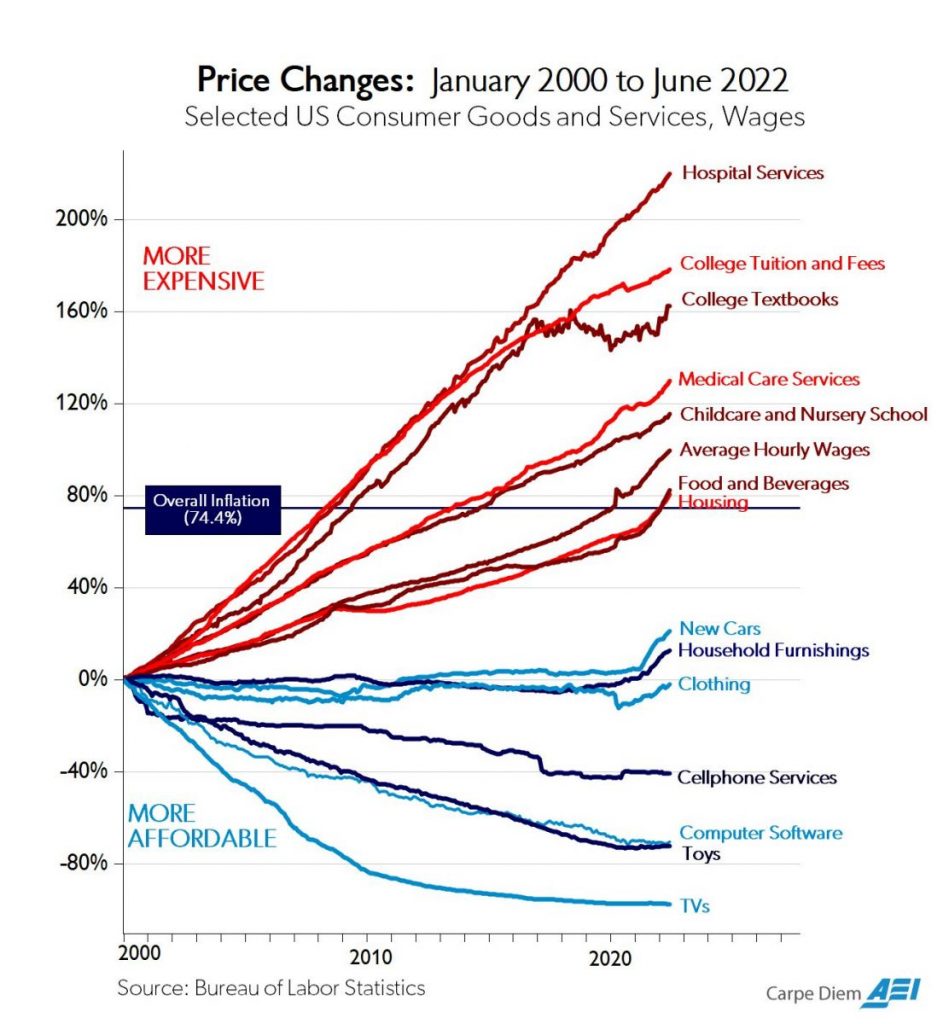
1. You don't need to take everyone's job. You just need to take a shitload of people's jobs. I think a lot of our current sociological problems, problems associated with wealth inequality, etc., are due to the fact that lots of people no longer have competitive enough skills because technology made them obsolete.
2. The state of AI progress makes it impossible for humans in many fields to keep up. Imagine if you spent your entire career working on NLP, and now find GPT-4 will run rings around whatever you've done. What do you do now?
I mean, does anyone think that things like human translators, medical transcriptionists, court reporters, etc. will exist as jobs at all in 10-20 years? Maybe 1-2 years? It's fine to say "great, that can free up people for other thing", but given our current economic systems, how are these people supposed to eat?
EDIT: I see a lot of responses along the lines of "Have you seen the bugs Google/Bing Translate has?" or "Imagine how frustrated you get with automated chat bots now!" Gang, the whole point is that GPT-4 blows these existing models out of the water. People who work in these fields are blown away by the huge advances in quality of output in just a short time. So I'm a bit baffled why folks are comparing the annoyances of ordering at a McDonald's automated kiosk to what state-of-the-art LLMs can do. And reminder that the first LLM was only created in 2018.